Alcohol and health
Alcohol units: calculate your drinks and understand the weekly guideline
On this page
“A couple of drinks” can mean very different amounts of alcohol. Two small beers, two large glasses of wine and two generously poured spirits are not equivalent. Units let you compare the alcohol itself, provided you know the size and strength of each drink.
The UK weekly guideline is no more than 14 units regularly, for both men and women. Understanding that number takes two steps: calculating what you drink, then considering the amount and pattern together.
If you may be physically dependent on alcohol, seek medical advice before abruptly stopping or making a large reduction. A unit total cannot tell you whether withdrawal will be safe.
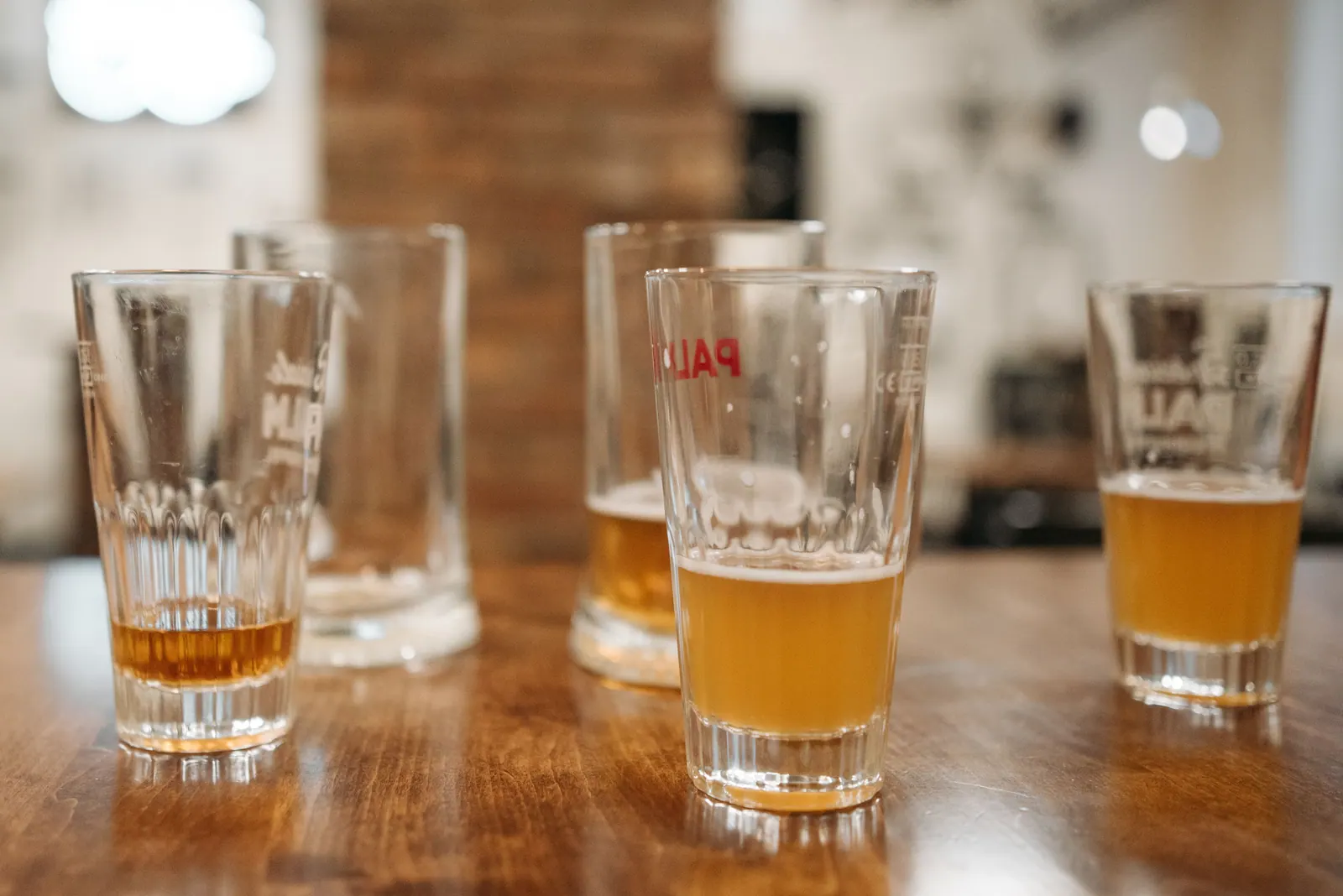
How do you calculate the units in your drink?
The NHS defines one UK unit as 10 ml or 8 g of pure alcohol. Multiply the drink's volume in millilitres by its alcohol by volume percentage, then divide by 1,000:
Units = volume in ml × ABV percentage ÷ 1,000.
Use the number before the percentage sign. For a 5% drink, enter 5, not 0.05, in this version of the formula. A 500 ml can at 5% contains 500 × 5 ÷ 1,000 = 2.5 units.
A UK pint is 568 ml. The same calculation gives 2.272 units for a pint at 4%, or about 2.3. At 5.2%, a pint contains 2.9536 units, usually rounded to 3. That difference matters when several pints are added together.
Check whether the label gives units for a serving or the whole container. If it gives a container total, you do not need to multiply that by the suggested number of servings. For draught drinks, ask the staff about strength when it is unclear.
Here are some common servings, calculated using the stated strengths and rounded for a practical record:
- A 440 ml can at 4%: 1.8 units; the same can at 7%: 3.1.
- A 568 ml pint at 4%: 2.3 units; at 5.2%: 3.
- A 125 ml glass of 13% wine: 1.6 units.
- A 175 ml glass of 13% wine: 2.3 units.
- A 250 ml glass of 13% wine: 3.3 units.
- A 750 ml bottle of 13% wine: 9.8 units.
- A 25 ml measure of a 40% spirit: 1 unit; 35 ml: 1.4; 50 ml: 2.
Use the actual label for your drink. A smaller container can contain more alcohol than a larger one if its strength is sufficiently higher. Two of those 440 ml cans provide about 3.5 units at 4%, compared with 6.2 at 7%. Both might be remembered simply as two beers.
What about a home pour or a cocktail?
Wine glasses rarely tell you where 175 ml ends. Measuring your usual pour once can resolve a substantial uncertainty in your weekly record. Also count top-ups: three occasions on which a glass was filled do not necessarily equal three measured servings.
Half a 750 ml bottle at 13% contains about 4.9 units. Recording half each works if two people split it equally. If one has a small glass and the other finishes the bottle, record those different quantities instead.
With spirits, count the alcoholic ingredients before adding mixers. At 40%, a 50 ml pour contains two units whether it is served neat or in a tall glass with ice and tonic.
For a cocktail containing 30 ml of a 40% spirit and 20 ml of a 20% liqueur, the two ingredients contribute 1.2 and 0.4 units: 1.6 in total. Any other alcoholic ingredient needs adding too. The cocktail's name alone cannot establish its units because recipes differ.
For a ready-mixed can, use the final ABV and volume printed on the container. You do not need to reconstruct its recipe. When a restaurant pour or mixed drink cannot be checked, record your best estimate and label the uncertainty.
The glass alone does not tell you the units
- 1
Check the volume
Find how much is in the serving.
- 2
Read the strength
Use the drink's stated ABV.
- 3
Calculate the units
Use both figures rather than counting glasses alone.
What 14 units looks like in drinks
Six pints at 4% total about 13.6 units. Six 175 ml glasses of 13% wine total about 13.7. Five pints at 5.2% total about 14.8, already above the weekly guideline. These comparisons use unrounded figures before rounding the final total.
This is why a guideline expressed as a fixed number of glasses or pints can mislead. The difference between a 175 ml and a 250 ml wine serving, repeated four times, is 3.9 units at 13%. The glass size can change the week's total without changing the number of occasions you remember drinking.
Mixed drinks across a week are added in exactly the same way. Two 440 ml cans at 4%, two 175 ml glasses of 13% wine and a 50 ml measure of 40% spirit give 3.52 + 4.55 + 2 = 10.07 units, or about 10.1.
Keep the individual days beside that total. A record that says only 10.1 cannot show whether it came from several smaller occasions or one evening. Nor do unused units carry forward into the following week.
Find the change that fits how you drink
Write down the drink, quantity, strength and units close to the time you have it. Include home pours and drinks with meals. If you miss an entry, mark it as an estimate rather than dropping it from the total.
Beside each occasion, note what was happening. Was it a drink you chose with dinner, an automatic pour while cooking, a round you did not want, or an attempt to settle yourself before bed?
The automatic pour may call for changing what is within reach. The unwanted round may call for a sentence prepared in advance. Drinking because you feel unable to sleep may need a conversation about the sleep problem itself. Our guide to alcohol and sleep examines that situation.
For people able to cut down safely, the NHS suggests smaller servings, lower-strength drinks, several drink-free days and support from others. Turn the option into a specific change: a smaller measured glass at dinner, a lower-strength product you have checked, or a non-alcoholic choice for a particular occasion. Check the resulting weekly total as well as the number of drinks.
Can you save the week's units for one evening?
For people regularly drinking 14 units, the CMO guidance recommends spreading intake over at least three days. Concentrating drinking into one or two heavy episodes adds illness, accident and injury risks. Dividing a weekly total by seven does not show what happened on the heaviest evening.
For an individual occasion, the evidence report advises keeping the total down, slowing the pace, having food, alternating with water and arranging a safe journey home. It does not supply one universal session limit: risk varies with the person, speed of drinking and circumstances.
Make those choices before the occasion starts. For example, decide what you will order after your first drink and arrange your transport. If you are buying rounds with people drinking faster than you want to, you can buy separately or choose a non-alcoholic drink for a round. Food and water do not subtract units from the alcohol you have already consumed.
Does staying below 14 units remove the risk?
The Chief Medical Officers' report explains its risk basis: at or above the recommended level, the expected lifetime risk of dying from an alcohol-related condition is at least 1%. That is at least one in 100 over a lifetime, rather than a yearly probability or an individual's guaranteed maximum.
The shared limit reflects broadly similar overall risk for men and women near that level. The mix of harm differs: immediate accident-related harm is greater in men, while longer-term illness-related harm is greater in women.
Cancer risk also helps explain why being within the guideline does not eliminate harm. The 2016 evidence report underpinning it gave female breast cancer estimates of 16% higher relative risk at two units daily, and 40% higher at five daily, compared with non-drinkers. Those amounts correspond to 14 and 35 units a week. The figures concern relative increases in illness and death from that cancer, not 16 or 40 extra cases per 100 women. They come from the analysis used to develop the guideline, rather than a new study or a calculation of your personal risk.
The same evidence report describes increasing cancer risk from any regular intake. There is no sharp biological boundary at the fourteenth unit. A public guideline supplies a usable reference point across a population; your age, health and medicines still belong in a discussion about your own drinking.
If you are pregnant or think you could become pregnant, the CMO guidance says avoiding alcohol is safest. Speak to your midwife or doctor about concerns over alcohol already consumed.
Can units tell you when it is safe to drive?
The government's drink-driving guidance explains that the legal alcohol limit cannot be translated into a fixed drink count for everyone. Do not turn a unit total into a countdown until driving.
West Midlands Police warns that alcohol can remain the next morning even if you feel fine. Coffee, fresh air and cold showers do not speed its removal. Arrange a lift, taxi or public transport before drinking, and consider the following morning's journey too.
When medical support comes first
The NHS recommends seeking help if you often feel you need a drink, other people warn you about your intake, or you think drinking is causing problems. A GP can discuss assessment and support, including local alcohol services.
If you are physically dependent, stopping overnight can be harmful. Morning anxiety, sweating, tremor, nausea, retching or vomiting can indicate withdrawal and a need for medical help. Call 999 for severe withdrawal symptoms such as hallucinations, severe tremors or seizures.
You do not need a perfectly completed diary before asking for help. Bring what you know: the drinks, approximate quantities, frequency, and what happens when you try to cut down. That gives the person helping you something concrete to work with.