Which exercise ball workout should I start with?
Start with a ball crunch, bridge and dead bug twice a week. In one small study, the wobble made a crunch work your abs harder. But two other moves worked them hardest in a lab.
On this page
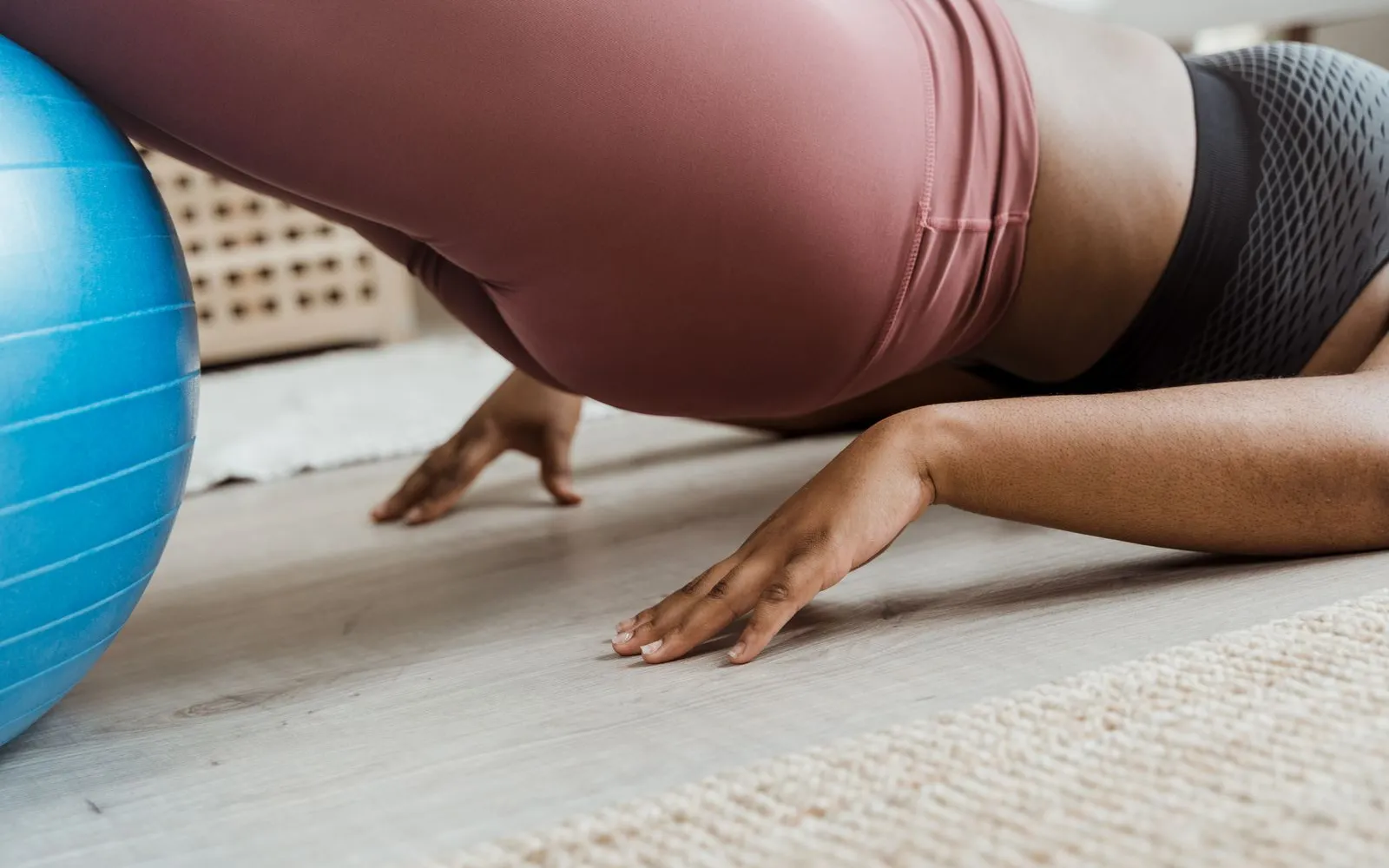
What is a good exercise ball workout for beginners?
Five moves: a ball crunch, a ball bridge, a dead bug, a back lift and a wall squat. Together they work your stomach, back, bottom and legs.
The NHS says adults should work every major muscle, including the abdomen, on at least 2 days a week. These five cover a lot of that.
| Move | How | Reps |
|---|---|---|
| Ball crunch | Lie back with your shoulder blades on the ball. Tuck your chin and reach your hands to your knees. | 15 |
| Ball bridge | Lie on your back, lower legs on the ball. Push into it to lift your hips. | 10 |
| Ball dead bug | On your back, squeeze the ball between your hands and knees. Lower one leg and the opposite arm. | 5 each side |
| Back lift | Lie on your front over the ball. Lift with your lower back, eyes on the floor. | 15 |
| Wall squat | Ball between your lower back and a wall, feet a little forward. Bend your knees to roll it down. | 15 |
Sources: KMPT NHS physiotherapy; The Prehab Guys: ball dead bug; hamstring curl
The crunch, back lift and wall squat reps come from an NHS physio leaflet. The other reps are a simple start, not a study finding.
On the dead bug, don’t let your low back arch. The Prehab Guys, who teach physios, flag that as the common slip.
Pregnant? In later pregnancy, the NHS says try to avoid lying flat on your back for more than a few minutes.
It also says to avoid activities where you could fall. Ask your midwife before using a ball.
Pick 2 days this week and do the five moves once through.
What size exercise ball do I need?
Go by your height. Most adults need a 55, 65 or 75 cm ball. A gym ball, Swiss ball, yoga ball and stability ball are all the same thing.
| Your height | Ball size |
|---|---|
| Under 150 cm | 45 cm |
| 150 to 165 cm | 55 cm |
| 162 to 183 cm | 65 cm |
| 180 to 200 cm | 75 cm |
| Over 198 cm | 85 cm |
Source: Oxford Health NHS
Between two sizes? Sit on the ball. Your hips and knees should be at right angles, with your feet flat on the floor.
Buy one marked burst resistant. A firmer ball makes each move harder, so start a little softer.
Which exercise ball ab workouts work hardest?
The roll-out and the pike. Those are the two moves that come later.
In a lab study, 18 people tried 8 ball moves plus a crunch and a sit-up. The roll-out and pike made the stomach muscles work hardest.
The wobble matters too. In 8 healthy men, the main stomach muscle worked at 21% of its maximum in a floor curl-up. With their upper back on a ball, it was 35%.
Both studies measured one session of muscle effort, not strength gained over weeks.
Build up to the hardest ball ab moves
- 1
Ball dead bug
Squeeze the ball between your hands and knees. Low back stays down.
- 2
Ball plank
Elbows on the ball, toes on the floor. Hips don’t sag or shoot up.
- 3
Stir the pot
Once you can hold a ball plank, stir the ball in small circles.
- 4
Roll-out and pike
The two moves that worked the abs hardest in the lab. Learn them with a coach or physio once stir the pot feels steady.
Sources: The Prehab Guys: ball plank; stir the pot; Escamilla 2010
Want a flatter stomach? Ab work alone may not do it. In a 6-week trial in 24 inactive adults, 7 ab moves 5 days a week didn’t shrink waists.
For floor moves to mix in, see core and ab exercises.
What are balance ball exercises?
Moves you do sitting on the ball. Sit up straight, shoulders back and down, feet hip width apart. Keep your upper body still and let your hips move the ball.
| Move | How | Reps |
|---|---|---|
| Forward and back | Roll the ball forward and back with your hips. | 20 |
| Side to side | Roll the ball left and right with your hips. | 20 |
| Eyes shut | Feet together, eyes closed. Stay still. | 10 to 20 seconds, 5 times |
| One foot | Lift one foot off the floor and stay upright. | 10 to 20 seconds, 5 times each leg |
Source: KMPT NHS physiotherapy
Start with your feet wide. Shut your eyes or lift a foot only once that feels easy, with a wall or sturdy chair within reach. For standing balance work as you get older, see balance training.
Is a ball better than the floor or weights?
Not for building strength for sport. The Canadian Society for Exercise Physiology says a wobbly base can cut force, power and range of movement. So it isn’t the main tool for athletes.
Squats and deadlifts on solid ground can work your core as hard or harder. But the same experts say ball work can help people who would rather not lift free weights.
Your exercise ball week
- Do the five starter moves on at least 2 days a week.
- Check your ball size: sitting on it, your hips and knees should be at right angles.
- Add the seated balance moves on the same days, or while you sit at home.
- Once a ball plank feels steady, add stir the pot.
- Keep some strength work on solid ground too, such as squats.
- Stop if you feel dizzy, or get pain or a new symptom, and get advice.
Sources: NHS; Oxford Health NHS; KMPT NHS physiotherapy; CSEP
Want to go harder? The ball bridge turns into a hamstring curl: roll the ball in toward your hips, keeping your hips up. ACE rates it intermediate.
For no-kit strength work, see strength training at home and how many sets and reps.
When to speak to a GP
Speak to a GP if:
- You haven’t exercised for some time, or you have medical conditions or concerns. The NHS says speak to your GP first.
- You feel dizzy, or get pain or a new symptom while you exercise. NHS physios say stop and get advice.
- You have back pain and the exercises make it worse. The NHS says stop and see a GP.
- You think you have a hernia: a lump in your groin, upper thigh or tummy that may get bigger when you cough, sneeze or cry. See a GP. Get help from 111 if you have a hernia and pain in or around it, a bloated tummy, you feel sick or are being sick, or your vomit has blood in it or looks like coffee grounds. The same goes if you’re constipated, have a high temperature, feel hot, cold or shivery, or are suddenly confused.
- You’ve had a baby and the gap between your stomach muscles is still obvious 8 weeks after the birth. The NHS says contact the GP. After a birth, try to avoid sit-ups and planks to start with.
Call 999 or go to A&E if you have back pain and pain, tingling, weakness or numbness in both legs. The same goes for loss of feeling around your genitals or anus, or changes in your bladder or bowels.
Also call if your back pain comes with changes in how your penis or vagina feels during sex. Or if you can’t get or keep an erection, or can’t orgasm. The same goes for chest pain, or back pain that started after a serious accident.
Back pain? See back strengthening exercises, or try pilates at home.