Can you check blood sugar without finger pricks?
Yes, with a small sensor under your skin. It cuts most finger pricks, but not all. And no watch or ring that skips the sensor is medically approved.
On this page
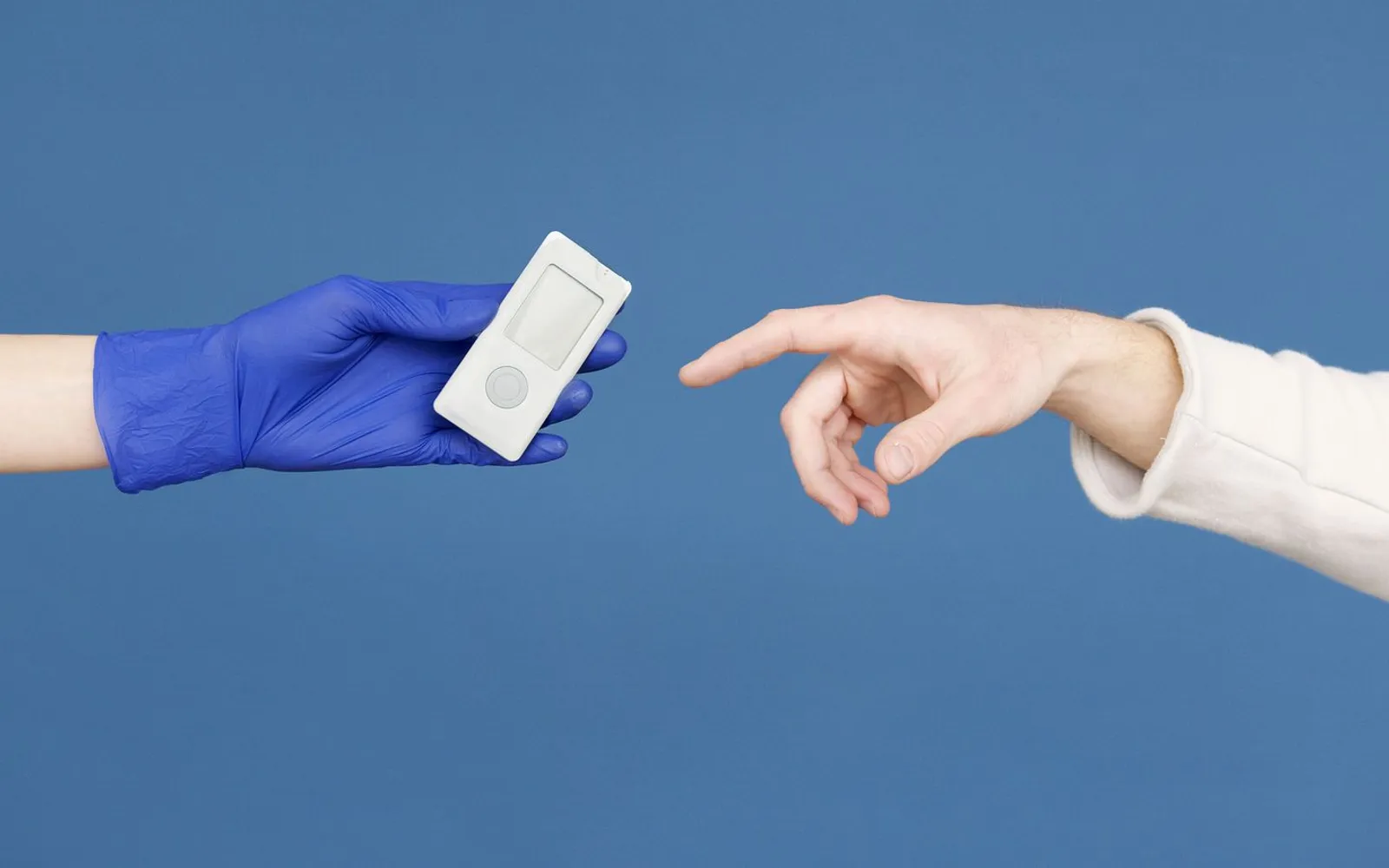
Can you check blood sugar without finger pricks?
Mostly, yes. A continuous glucose monitor (CGM) is a small sensor that sits under your skin, day and night. It sends your sugar readings to your phone or a reader.
You put it in with an applicator, a small tool that pushes it under your skin. Then you can check your sugar without pricking your fingers. You can also set an alarm for when it goes too low or too high.
| Option | What it reads | On the NHS? |
|---|---|---|
| Finger-prick meter | A drop of blood from your fingertip. | Yes, on prescription. |
| CGM sensor | The fluid just under your skin, all day. | Yes, for many people with diabetes. |
| Watch or ring with no sensor | Claims to read sugar through the skin. | No. Not medically approved. |
Sources: Diabetes UK; FDA
A CGM swaps most of your finger pricks for a quick look at your phone. It doesn’t swap them all.
Have diabetes? Ask your diabetes team whether a CGM suits you.
Do non-invasive glucose monitors work?
There’s no proof they do. These watches and rings claim to read your sugar through the skin, with no sensor.
The US regulator, the FDA, has not approved any watch or ring that measures blood sugar on its own. In February 2024 it told people not to buy or use them.
Diabetes UK doesn’t recommend them: cheap ones sold online don’t have to pass medical-device testing, so no one knows if they’re accurate.
A wrong reading can lead to the wrong dose of insulin or another sugar-lowering medicine. Too much can push your sugar dangerously low.
A watch that shows readings from a CGM sensor is different, and you may be able to link the two.
Already own one? Don’t use it for your sugar readings. Never stop or change a prescribed medicine without your prescriber.
Why do I still need finger pricks with a CGM?
A CGM reads the fluid around your cells, not your blood. That fluid can lag behind your blood sugar by up to 15 minutes.
Think of live TV on a short delay. Most of the time it doesn’t matter. But the gap is more likely to grow when you’re eating or exercising, as your sugar moves fast.
So when you need to act on a number, a finger prick shows you now. That’s why you keep your meter.
| Moment | What to do |
|---|---|
| Your reading doesn’t match how you feel | You may want to check with a finger prick. |
| You’re treating a hypo (low sugar, usually below 4 mmol/L) | A finger prick gives the most accurate result. |
| Your sugar is changing fast, or the sensor stops working | Use your meter as a back-up. |
| Driving on insulin: a reading of 4 or below, hypo signs, or an alert that a hypo is coming | Confirm with a finger prick, and at other times the maker advises. Carry your meter and strips. |
Sources: Diabetes UK; NICE NG28; NHS
NICE says adults with type 2 diabetes on a CGM still need finger pricks, just less often, and should get enough test strips. So keep your meter and strips on prescription.
For what your numbers mean, see blood sugar levels by age.
Can I get a CGM on the NHS?
Most people with type 1 diabetes should be offered one. Some people with type 2 can too. The rules differ a little across the UK.
| Who | Guidance |
|---|---|
| Adults with type 1 | Offer a choice of CGM types. |
| Under 18s with type 1 | Should be offered one. |
| Pregnant with type 1 | Should be offered one. |
| Type 2 on several insulin injections a day | Offer one if hypos are frequent or severe, you don’t notice them, a condition stops you doing finger pricks but you could use a sensor, or you’d need 8 or more a day. |
| Type 2 on insulin, needing a carer to check your sugar | Offer one. |
Sources: NICE NG17; NICE NG28; Diabetes UK
Don’t qualify? You can pay for one. Diabetes UK says they cost about £50 to £150 a month, depending on the device.
Make your case to your diabetes team first. They can sometimes lend you one for a short time.
What should I check before buying a glucose monitor?
Five checks before you buy a glucose monitor
- Ask your diabetes team whether you qualify for a CGM on the NHS.
- Skip any watch or ring that claims to read your sugar with no sensor.
- Keep your finger-prick meter and strips, even with a CGM.
- Check the sensors match your device, as one CGM’s sensors won’t work in another.
- Report a safety problem with your CGM to the MHRA Yellow Card scheme. Send faulty sensors back to the maker for a replacement.
Sources: Diabetes UK; FDA; NICE NG28
No diabetes? NICE’s CGM advice is for people who have it. To find out if you do, the check is a blood test, such as the diabetes blood test and the HbA1c test.
For what a sensor can and can’t show if you don’t have diabetes, see CGM vs HbA1c.
When to speak to a GP
Ask for an urgent GP appointment or call 111 if you or your child has signs of diabetes. These include feeling thirsty all the time, peeing more than usual, feeling very tired or losing weight without trying.
See a GP if:
- You have diabetes and get hypos often, or you’ve had severe hypos or hypos at night.
- You have diabetes and don’t always notice the signs of a hypo.
- You don’t have diabetes but get hypo signs, such as shaking, sweating, a fast heartbeat and feeling confused.
- You have a higher chance of diabetes. Not everyone with it has symptoms.
Someone with very low sugar is unconscious or not responding normally? Call 999 if there’s no glucagon (an emergency hypo injection) or you don’t know how to use it.
Also call 999 if they haven’t recovered within 10 minutes of glucagon, or they’ve been drinking alcohol.