Does PCOS cause belly fat?
It often does, around the middle. Women with PCOS are more likely to carry belly fat, yet studies find no clear sign they eat more. Two hormones help explain why.
On this page
Does PCOS cause belly fat?
Often, yes. The NHS lists weight gain or difficulty losing weight as a main symptom of PCOS. The NHS now calls it PMOS.
A review of 35 studies and over 15,000 women found women with PCOS were more likely to carry extra fat around the middle. The studies varied a lot, so treat these numbers as rough.
| What the review measured | With PCOS, compared with without |
|---|---|
| Overweight | Nearly 2 times as likely |
| Obesity | Nearly 3 times as likely |
| Extra fat around the middle | About 1.7 times as likely |
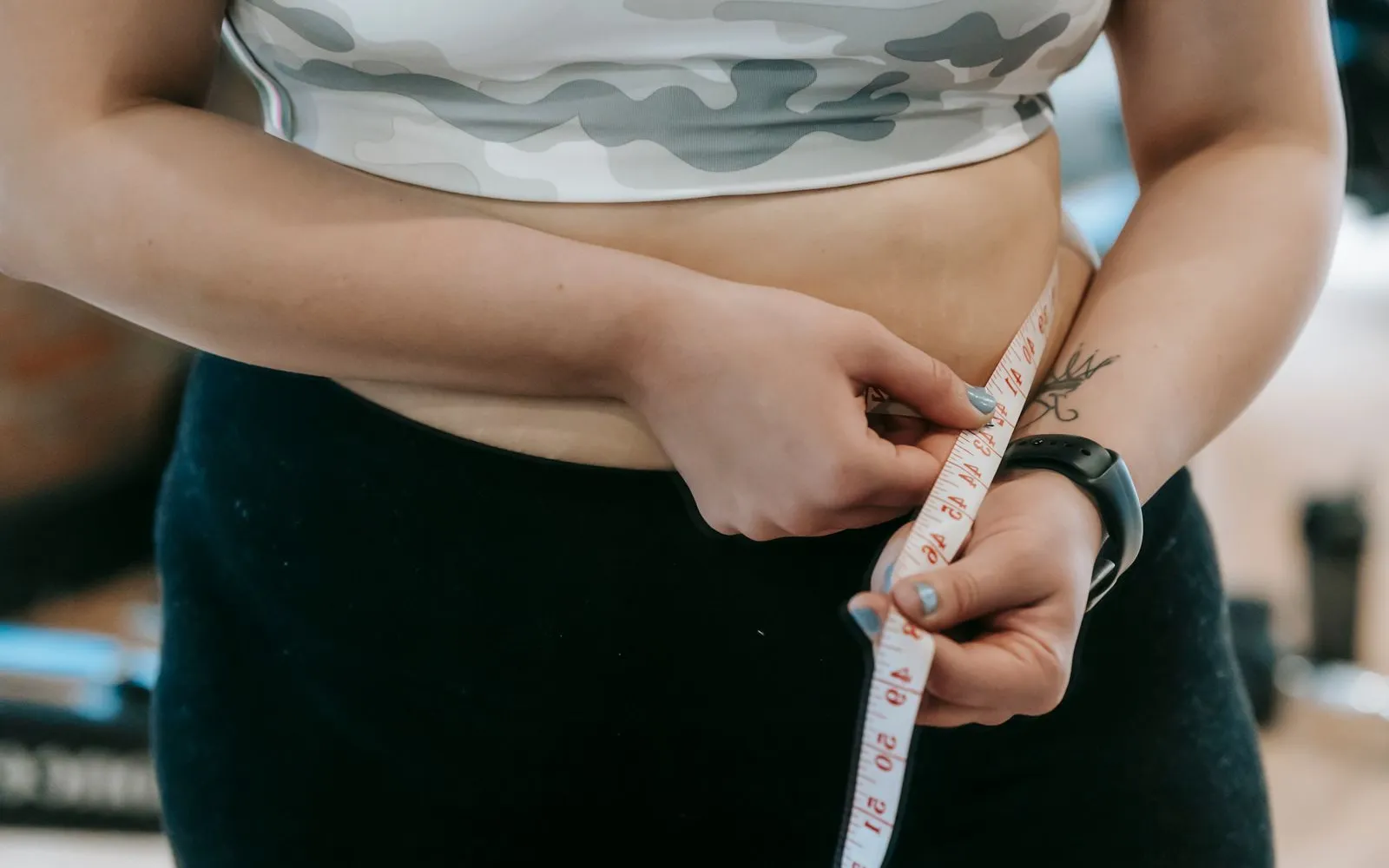
More likely doesn’t mean every woman with PCOS gains belly fat. Grab a tape measure: your waist is the number to watch, and section 5 shows how.
Why does PCOS cause weight gain?
The exact cause isn’t known. The NHS says PCOS may be to do with insulin and testosterone not working properly.
Those are the two hormones. Testosterone is a hormone women make in small amounts.
Insulin moves sugar from your blood into your cells. In insulin resistance, your body needs more insulin to do the same job.
How insulin and testosterone can feed each other
- 1
More insulin
High insulin pushes up testosterone in PCOS.
- 2
More testosterone
It can add fat deep inside the belly.
- 3
Belly fat
Fat around the middle can cause insulin resistance.
- 4
Back to the start
Testosterone also adds to insulin resistance in PCOS.
Sources: Endocrine Reviews 2012; Diabetes UK
The 2023 PCOS guideline found no consistent evidence that women with PCOS eat or move differently. It says many have something underneath that drives more weight gain over time.
See our high testosterone in women guide for the hormone side.
What does a PCOS belly look like?
“PCOS belly” isn’t a medical term. People use it for fat that sits more around the tummy than the hips and thighs.
Researchers call this the typical male pattern. Studies that measured waists and hips suggest it’s more common in PCOS.
But when scans compare women of the same weight, those with PCOS don’t have more deep belly fat. So the extra belly fat in PCOS seems to go with extra weight overall.
The NHS doesn’t list a belly shape as a sign. It uses blood tests and sometimes a scan of your ovaries. See the PCOS blood test guide for what gets checked.
Could my belly fat be something else?
Yes. Other conditions can add weight, and some look like PCOS. The PCOS guideline says doctors should rule out Cushing’s syndrome when it fits.
| Condition | Other signs the NHS lists |
|---|---|
| PCOS | Irregular periods, extra hair growth, oily skin or acne. |
| Cushing’s syndrome (too much of a hormone called cortisol) | Fat on the neck, upper back, chest and tummy, with thin arms and legs. A red, round face. Stretch marks. |
| Underactive thyroid | Feeling extremely tired, feeling cold more than usual, constipation. |
Sources: NHS: PMOS; NHS: Cushing’s syndrome; NHS: underactive thyroid
Cushing’s is rare. The NHS says the most common cause is taking high doses of steroid medicine for a long time.
Compare the lists in PCOS vs thyroid symptoms and does cortisol cause belly fat. Take the signs that fit you to your GP.
What’s the best way to lose weight with PCOS?
Eat a bit less and move more. The guideline says diet and exercise improve fat around the middle in PCOS.
Six steps for a PCOS belly
- Measure your waist halfway between the bottom of your ribs and the top of your hip bone.
- Try to keep your waist to less than half your height.
- Pick a healthy diet you can keep up. No diet has been shown to work better in PCOS.
- To lose some weight, aim for at least 250 minutes of moderate activity a week, or 150 minutes of vigorous, if you’re 18 to 64. Moderate means you can talk but not sing. Vigorous means a few words, then a pause for breath.
- Add muscle strengthening on 2 days a week that aren’t back to back.
- If you’re an adult with PCOS and a BMI of 25 or more, ask your GP whether metformin, a type 2 diabetes medicine, could help.
Sources: Diabetes UK; NHS; International PCOS guideline 2023; NHS: activity guidelines
If you’re 165cm tall, half your height is 82.5cm. Divide your waist by your height, both in cm.
- Below 0.5 ratioNICE: no increased health risks.
- 0.5 to just under 0.6 ratioNICE: increased health risks.
- 0.6 ratio or aboveNICE: further increased health risks.
Sources: NICE NG246; NHS
These bands are for a BMI (weight compared with height) under 35. Skip them if you’re pregnant, or have or think you have an eating disorder.
Expect slow change. In small, low-quality trials, diet and exercise may cut about 1.7kg more than little or no help. They may also lower a testosterone measure, the testosterone part of the loop.
The guideline says a healthy lifestyle has benefits even without weight loss. For meal and activity plans, see PCOS weight loss.
Never stop or change a prescribed medicine without your prescriber.
When to speak to a GP
Book an appointment if:
- You think you might have PCOS, or your symptoms affect your everyday life, work or relationships. The NHS says see a GP.
- You have signs of Cushing’s syndrome, particularly if you take steroid medicine.
- You think you might have an underactive thyroid.
- Your BMI is overweight or obese and your waist is more than half your height. The NHS says see a GP.
- You have, or think you may have, an eating disorder, such as binge eating.
If you have PCOS, the guideline says your blood sugar should be checked at diagnosis, then every 1 to 3 years depending on your risk. Ask when yours was last done. Our insulin resistance blood test guide explains the options.