Indian diet plan for weight loss
Keep your usual food. Measure the oil first. Dal, roti and sabzi all fit. But if your family is South Asian, the NHS says overweight starts at a BMI of 23, not 25.
On this page
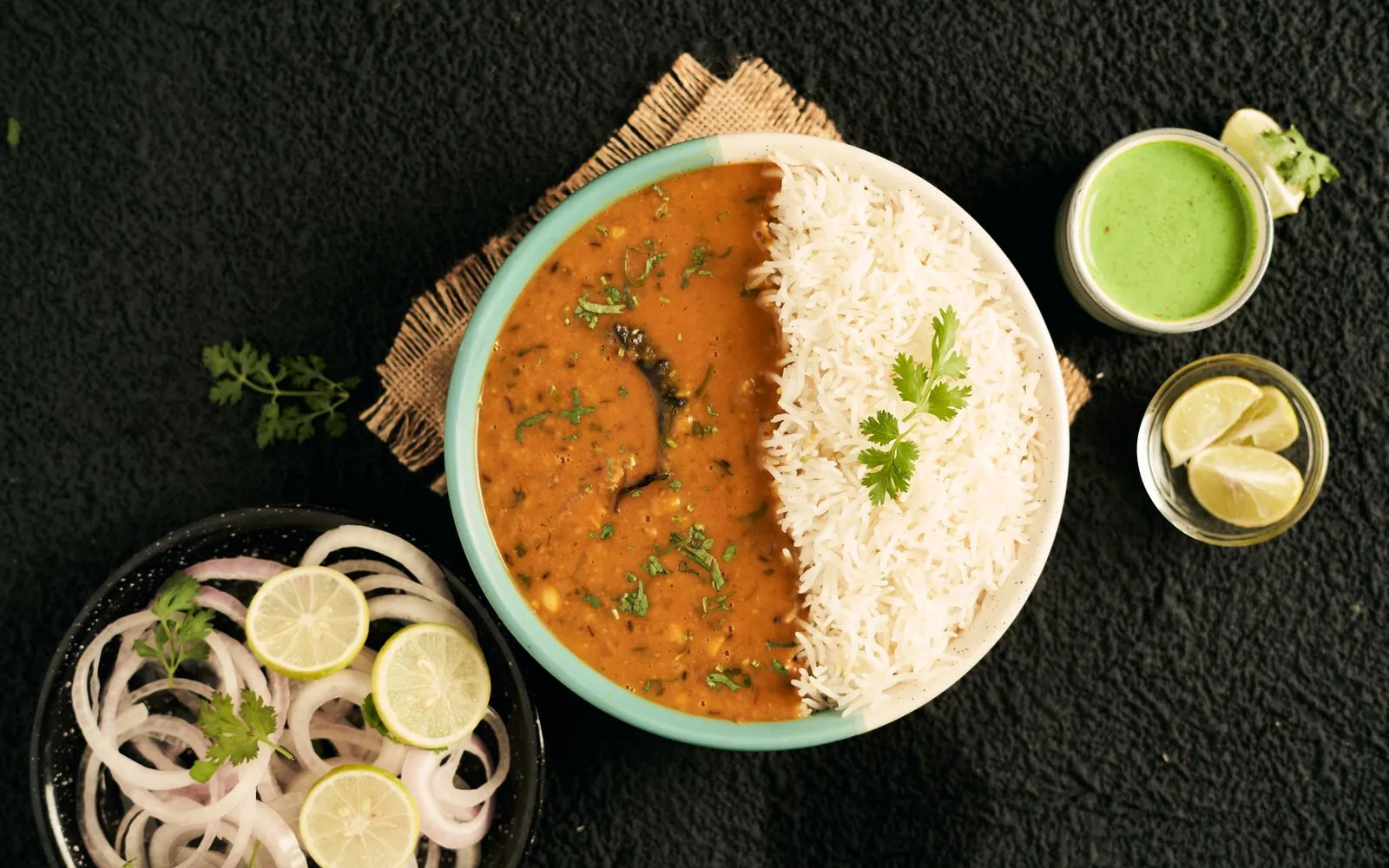
What is a good Indian diet plan for weight loss?
One built from the food you already cook, in smaller amounts. The NHS says to eat around 600 calories a day less than you do now. It calls that safe and sustainable.
Most meals below follow the NHS plate: about half veg, some protein like dal, beans, fish, eggs or lean meat, and one starch.
| Day | Lunch | Dinner |
|---|---|---|
| Monday | Moong dal, cucumber raita with low-fat yoghurt, 1 wholemeal roti | Chicken tikka with a big salad and a small bowl of basmati rice |
| Tuesday | Chana chaat with onion, tomato and cucumber | Mixed vegetable curry, dal and 1 wholemeal roti |
| Wednesday | Leftover vegetable curry with salad and 1 roti | Fish curry in a tomato sauce, green beans and basmati rice |
| Thursday | Rajma (kidney beans) with brown rice and salad | Egg bhurji with peppers and onion, 1 wholemeal roti |
| Friday | Sambar with 2 idli | Tandoori chicken or paneer tikka with salad and a roasted papad |
| Saturday | Vegetable poha with peas | Chicken or chickpea curry in a tomato sauce, extra veg, plain rice |
| Sunday | Dal with steamed bhindi and 1 roti | Keema with peas, made with lean mince, and 1 roti |
Sources: NHS Better Health; Diabetes UK
For breakfast, rotate three: vegetable upma, oat porridge with fruit, or a 2-egg masala omelette with 1 roti.
Don’t like a dish? Swap in one you do and keep the same plate shape. This week, measure the oil before every curry.
How do I make Indian food healthier?
Start with the oil. Every gram of fat has 9 calories, more than twice the 4 in carbs or protein. Free pouring adds up fast.
Diabetes UK says 1 to 2 teaspoons of oil is usually enough for a curry or dal for four people.
Six swaps for Indian home cooking
- Measure oil and ghee with a teaspoon. Usually 1 to 2 teaspoons of oil feeds a family of four.
- Eat roti instead of puri, made with wholemeal flour and no butter or ghee.
- Have roti or rice. If you have both, make both portions smaller.
- Steam bhindi instead of frying it, and roast papad instead of frying it.
- Swap oily pickles for garlic (lasan) or coriander (dhana) chutney.
- Have fresh fruit for dessert and save gulab jamun for special occasions.
Sources: Diabetes UK; NHS Better Health
Ghee, like butter, is high in saturated fat. The government says men should have no more than 30g of it a day, and women no more than 20g.
Cooking with less ghee? Use rapeseed, sunflower or olive oil, still in small amounts.
Vegetarian? See high protein vegetarian meals.
How much rice and roti can I eat?
You don’t have to give them up. The NHS says to keep starchy food like rice and roti to no more than a third of what you eat each day. Choose wholegrain when you can.
The catch is the size of the scoop. Rice swells as it cooks, so a big plate can hide a lot.
Source: NHS Better Health
So for your first week, weigh rice before you cook it. You don’t have to do it forever.
Pick basmati or easy cook rice. Diabetes UK says they keep you fuller for longer because they release energy slowly. For more on daily numbers, see calories to lose weight.
Which Indian takeaway is best for weight loss?
Pick tandoori or madras dishes, not creamy ones. That’s the government advice for Indian takeaways.
| Choose | Instead of |
|---|---|
| Tandoori or madras with chicken, prawns or vegetables | Creamy curries such as korma, pasanda or masala |
| Plain rice | Pilau rice |
| Chapati | Naan |
| Roasted papad, or none | Fried poppadoms |
Sources: NI Direct; GOV.UK; Diabetes UK
Poppadoms can add a lot of fat and calories to a meal. Add a vegetable side or dhal. Next time you order, ask for a chapati in place of the naan.
What is a healthy weight for South Asian people?
BMI (body mass index) compares your weight with your height. For most adults, the NHS says a BMI of 25 to 29.9 is overweight, and 30 or more is obese.
The overweight line is 23 if your background is South Asian, Chinese, other Asian, Middle Eastern, Black African or African-Caribbean. The NHS says you’re at risk of health problems with a slightly lower BMI.
- Below 23 BMIBelow the NHS overweight line.
- 23 to just under 27.5 BMINHS: overweight.
- 27.5 BMI or aboveNHS: obese.
Source: NHS
Type 2 diabetes is two to four times more likely in people of South Asian descent. If you’re South Asian, Diabetes UK says you’re more at risk from age 25, compared with 40 for white people.
You don’t need to reach 23 to see a benefit. Losing 5 to 10% of your body weight can improve your health. Aim to lose 0.5 to 1kg a week.
Work out yours with what your BMI means, then check your waist-to-height ratio.
When to speak to a GP
Have a health condition or a special diet? Talk to a GP before you change how you eat. The same goes if you have, or once had, an eating disorder.
The NHS also says to see a GP if your BMI is in the overweight or obese range and:
- you want help to lose weight
- your waist is more than half your height
- you have pre-diabetes (blood sugar higher than normal, but not diabetes), diabetes, high blood pressure, joint pain, high cholesterol, sleep apnoea (breathing that stops and starts while you sleep) or heart and blood vessel disease
- you have a family history of obesity
- you have, or think you may have, an eating disorder, such as binge eating
Worried about blood sugar? See prediabetes. For eating disorder support, the charity Beat helps adults and children.
More meal ideas: 7-day meal plan for weight loss.