Is low calorie peanut butter worth it?
Only the powdered kind cuts calories by much. No jar can legally say low calorie. And reduced fat saves only about 13 kcal per 15g, because something else fills the gap.
On this page
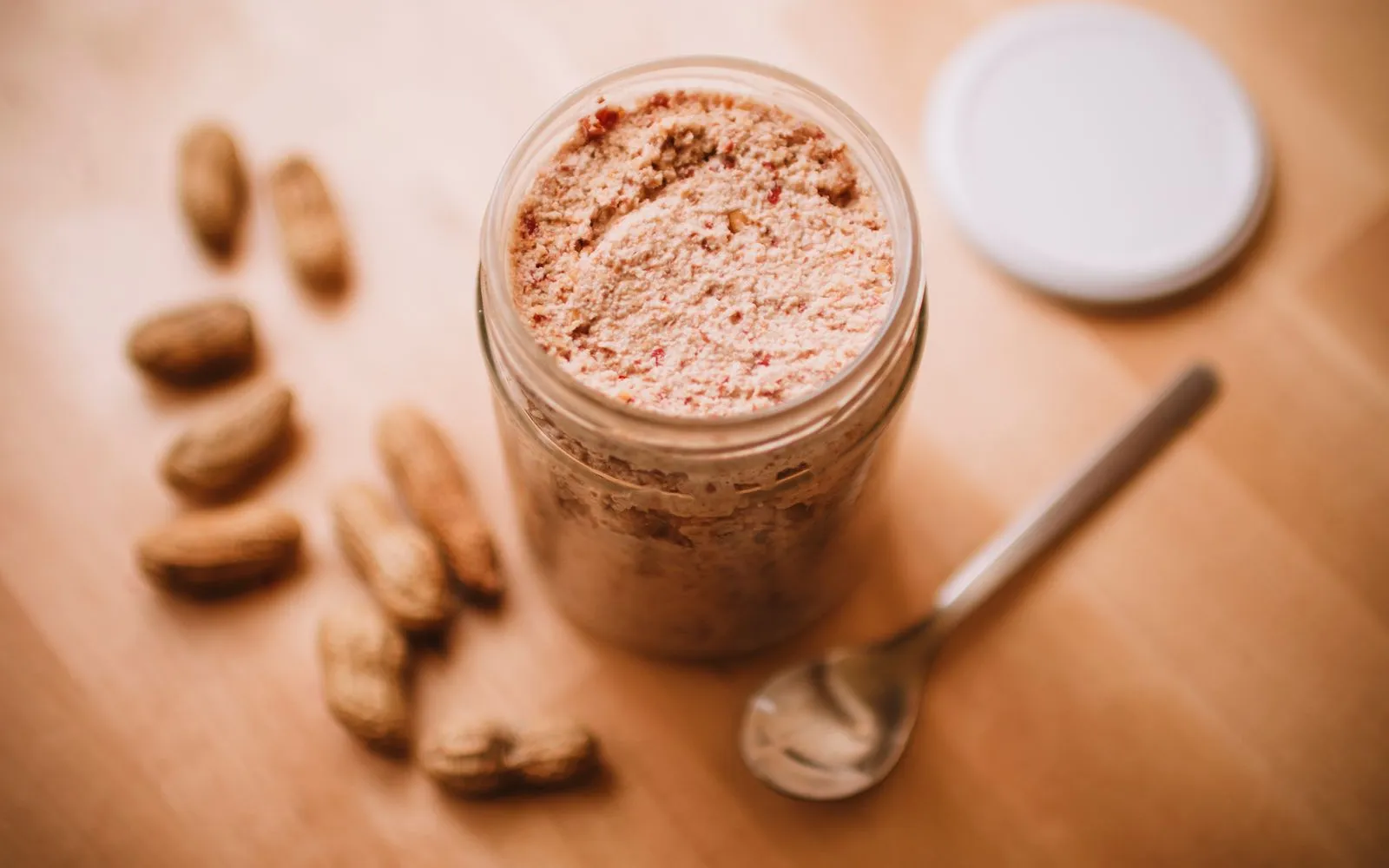
Is low calorie peanut butter worth it?
Only if it’s powdered. Peanut powder with the fat pressed out has about 49 kcal per 15g. Ordinary peanut butter has about 91.
You won’t see “low calorie” on a jar. By law, that claim needs no more than 40 kcal per 100g. UK smooth peanut butter has 607 kcal per 100g.
| Kind | Calories | Protein |
|---|---|---|
| Ordinary peanut butter | 91 kcal | 3.4g |
| Reduced fat peanut butter | 78 kcal | 3.9g |
| Peanut powder, fat pressed out | 49 kcal | 7.8g |
Sources: UK food tables (CoFID); USDA reduced fat; USDA peanut flour
The reduced fat and powder figures come from US food data. Jars in UK shops vary, so check the label.
Want the real thing? Weigh 15g once. Then you know what your usual spoonful adds up to.
Is reduced fat peanut butter lower in calories?
Only a little. In US food data, reduced fat smooth peanut butter has 520 kcal per 100g. Ordinary has 598, so it’s 13% fewer.
The gap is filled with carbs. Fat drops by about 17g per 100g, and carbs go up by about 13g.
Sources: USDA ordinary; USDA reduced fat
Think of calories as a price per gram. The NHS says fat costs 9 kcal a gram, and carbs and protein 4. Swap fat for carbs and you still pay part of the bill.
“Reduced fat” or “light” only means at least 30% less fat than a similar product. It says nothing about calories. So compare kcal per 100g on both jars, not the claim on the front.
Is powdered peanut butter a good swap?
For calories and protein, yes. Peanut flour with the fat pressed out has 327 kcal and 52g of protein per 100g. You stir it with water into a paste.
That makes about 64% of its calories protein. A food can say high protein from 20%. Ordinary peanut butter, at about 15%, can only say source of protein, not high protein.
The catch is the fat you lose. Peanuts carry a fat the NHS says helps protect your heart, by keeping good cholesterol steady while cutting bad cholesterol.
Shop powders vary. Some keep part of the fat: a partly defatted peanut flour has 428 kcal per 100g. Some add sugar or salt.
Check the label, then try it in porridge, yoghurt or a smoothie.
Is peanut butter OK for weight loss?
Yes, in a measured amount. You’re likely to lose weight if you eat fewer calories than you use. No single food decides that.
Nuts don’t seem to put weight on. Across 86 trials, people given nuts weighed about the same as those who weren’t, a difference of 0.09 kg. That was nuts in general, not peanut butter alone.
Fit it to your day. The NHS says an average woman needs 2,000 kcal a day and an average man 2,500. 15g of ordinary peanut butter is 91 of those.
Watch saturated fat too. 15g has about 1.9g. The NHS says men should have no more than 30g a day, and women 20g.
To set a daily number, try the calorie deficit calculator. For filling swaps, see high protein, low calorie snacks.
How to pick a peanut butter
| Words | What the law needs | For peanut butter |
|---|---|---|
| Low calorie | No more than 40 kcal per 100g | No jar gets close. |
| Reduced fat or light | At least 30% less fat than a similar product | Calories can stay close. |
| Energy-reduced | At least 30% fewer calories | The claim that cuts calories. |
| Reduced sugars | At least 30% less sugar, and no more calories | Little to cut: about 6.7g per 100g. |
| High protein | At least 20% of calories from protein | Powder can. Ordinary jars can’t. |
Source: Nutrition claims law
By NHS label rules, a typical UK smooth jar is high in fat and saturated fat. It sits in the middle for sugar and salt, at 6.7g sugars and about 0.9g salt per 100g.
Five checks before it goes in your basket
- Compare kcal per 100g, not the words on the front.
- Read the ingredients. They’re listed biggest first, so peanuts should come first.
- Check sugars and salt per 100g. High is more than 22.5g sugars or 1.5g salt.
- Weigh 15g once, so you know what your usual spoonful adds up to.
- Want a big portion? Use peanut powder mixed with water instead.
Sources: NHS food labels; Nutrition claims law
For other spreads and snacks, see the best nuts to eat and healthy fats.
When to speak to a GP
Peanuts are one of the most common foods people are allergic to. Get help if:
- You think you or your child may have a food allergy, such as an itchy rash, swollen lips or tummy pain after peanuts. See a GP.
- Your baby has a diagnosed food allergy or eczema, or the family has food allergies, eczema, asthma or hay fever. Talk to a GP or health visitor before giving peanut.
- Lips, mouth, throat or tongue suddenly swell, your throat feels tight, or you’re breathing very fast or struggling to breathe or swallow. Call 999.
- Skin, tongue or lips turn blue, grey or pale, someone is suddenly very confused, drowsy or dizzy, or faints and can’t be woken. Call 999.
- A child is limp, floppy or not responding like they normally do. Call 999.
Have an adrenaline auto-injector or nasal spray? Use it straight away, then call 999, even if you feel better.
Peanut can be introduced from around 6 months, finely ground or as a nut butter. Give one new allergy food at a time, so you can spot any reaction. To ask about testing, see the allergy blood test guide.