Strength progression
Progressive overload: when to add repetitions or weight
On this page
You finish twelve controlled repetitions with the same weight you used last week. Should you add a thirteenth, pick up the next dumbbell, or repeat the session? The answer depends on what happened across all your sets and how much harder the next weight would make the exercise.
Add repetitions while you are working towards the top of a chosen range. Consider a small weight increase when you can complete that range across your sets with consistent technique and some good repetitions still available. If extra weight makes the movement break down, return to the previous resistance or find a smaller step.
You can make this decision without taking every set to the point where another repetition is impossible. The 2026 ACSM position stand says training to momentary failure is unnecessary for benefits and proposes finishing with about two or three repetitions in reserve as one way to achieve sufficient effort.
A worked example: eight to twelve repetitions
For this beginner's example, use two sets of eight to twelve repetitions. Choose a resistance that lets you move under control and finish with roughly two or three good repetitions still possible. That estimate is called repetitions in reserve. The example is one way to organise progress; it is not a fixed prescription for every exercise.
- First session: eight repetitions in each set, with about three further good repetitions available.
- Next suitable opportunity: try nine in each set at the same resistance. Stop earlier if the movement deteriorates; the planned number does not override what you can perform.
- Later: twelve repetitions in the first set and ten in the second. Keep the weight while building the second set within the range.
- Once both sets reach twelve with the same technique and a little capacity remaining: repeat that performance at another session, then try the smallest practical increase in resistance.
Repeating the top performance before increasing helps you avoid basing the decision on one unusually good session. An exercise may take several sessions to reach the next step.
After adding weight, begin near the bottom of the range again. If you can perform eight controlled repetitions and still have a little capacity left, you have a workable new starting point. If you struggle to reach eight without shortening the movement or using momentum, the increase is too large for this plan. Return to the previous weight or use a smaller increment.
The last set matters. Reaching twelve easily in the first set does not mean the whole exercise is ready for a load increase if the second set remains much harder. Record each set rather than an average or a total that hides the difference.
Make sure you are comparing the same exercise
An exercise name is only part of the record. 'Row' might refer to different machines, a band or a dumbbell. Even on the same machine, changing the seat or grip can change the task. Before interpreting an increase as progress, make sure you know what the old number described.
Record the exercise, equipment, resistance, repetitions and sets. Add any setup detail you are likely to forget: seat setting, band colour, grip position or the version an instructor showed you. A set is a group of repetitions before a break. If rest periods are part of your programme, keep those reasonably consistent too.
A useful note might be: 'Seated band row; same blue band and approved anchor; two sets of ten; controlled return; last repetitions demanding.' That gives your next session a specific exercise and effort to compare.
If you are still learning the movement, the immediate task may be getting that setup right. Our guide to organising your first home strength sessions deals with that stage. Adding resistance to an exercise you do not understand will not make the comparison clearer.
Make one change at a time
- 1
Repeat your current work
Keep the movement and technique consistent.
- 2
Build repetitions
Work towards the top of your chosen range.
- 3
Then adjust resistance
A heavier weight usually means fewer repetitions initially.
How many good repetitions could you still do?
Repetitions in reserve means your estimate of how many more repetitions you could complete with the same technique. Three in reserve means the set is demanding, but you think three further good repetitions remain. You do not need to perform those extra repetitions to prove the estimate. Use it as a practical description of effort, especially while you are learning the movement.
At the end of a set, ask: could I do two more repetitions at that same pace and range, without changing how I move? Could I do five? The distinction between a few remaining repetitions and many is often enough to guide the next decision; treating an estimate as an exact measurement adds little.
If eight repetitions leave many more available, one extra repetition may be a sensible next step within your range. If the eighth already requires a shortened movement or an awkward swing, repeat an easier version and establish control before increasing. If you are unsure because the exercise itself is unfamiliar, repeat the current work or ask for a technique check.
The effort cue belongs to that exercise on that day. A resistance that felt easy on one movement may be difficult on another, and a later set can be more demanding than the first. Do not use a comfortable curl as evidence that the next squat weight is ready to increase.
What if the next dumbbell is a large jump?
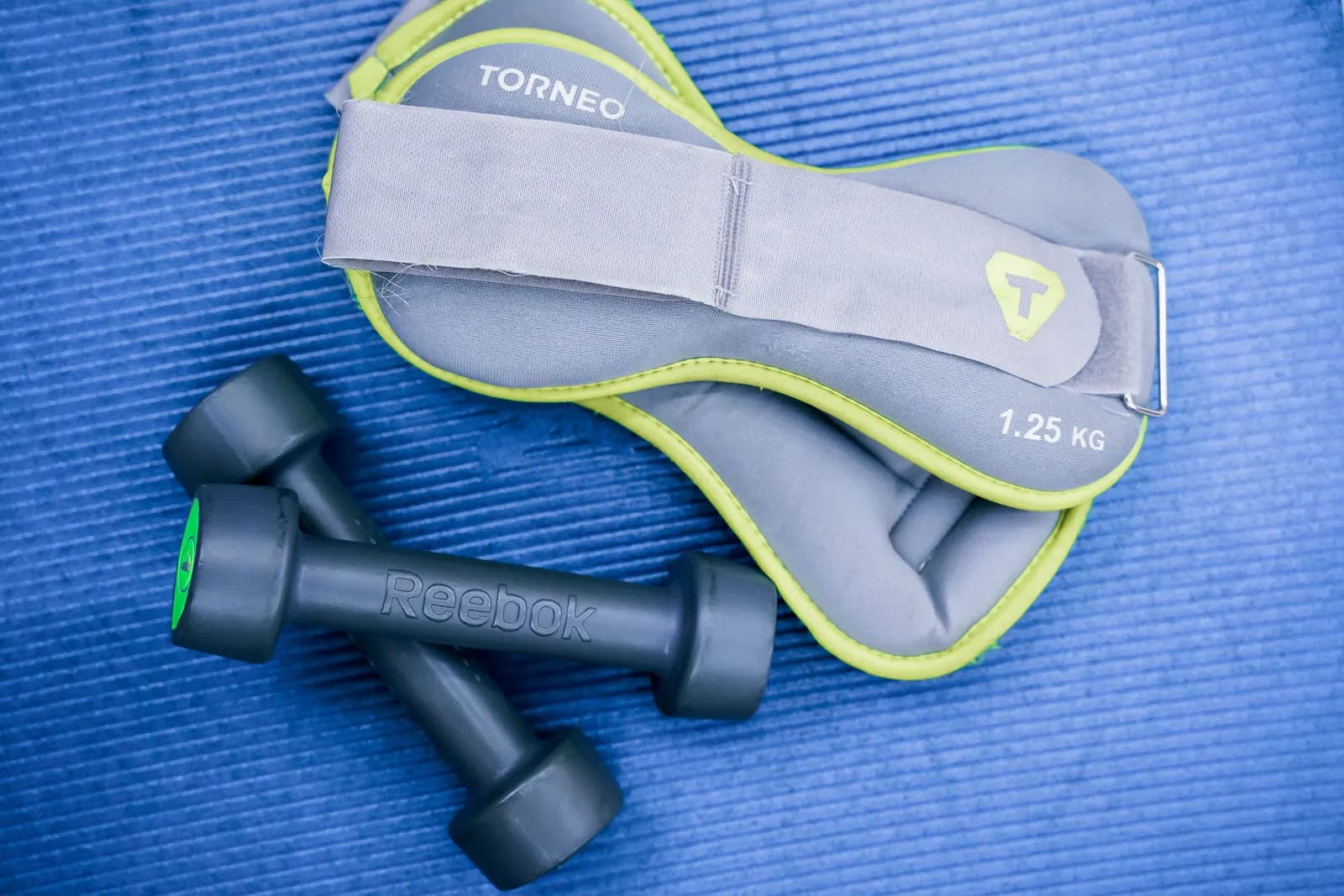
Home equipment often comes with awkward gaps. Moving from a 4 kg dumbbell to a 6 kg one is a 50% increase in its labelled weight, even though 'two extra kilos' sounds small. That arithmetic alone does not tell you whether the change suits an exercise, but it explains why the next available item may not be a modest progression.
Look first for a smaller increment that your equipment safely permits. If none is available, keep the current weight while progressing repetitions within the chosen range, or consider equipment with smaller steps. Once you are comfortably beyond the range, reassess the exercise rather than adding endless repetitions simply because the next dumbbell is too heavy.
A resistance band needs a different record. Colour is not a universal weight scale across brands, and changing your hand position or distance from an anchor changes the setup. Describe the band and position you used rather than assigning a kilogram figure you have not measured. Follow the equipment's anchoring instructions; increasing tension is not a reason to improvise a less secure attachment.
For bodyweight exercises, changing the variation can alter the task substantially. Treat a new version as something to learn and record in its own right. Ten repetitions of one variation and eight of another cannot be ranked by repetition count alone.
Will adding repetitions build strength too?
A 2022 randomised trial compared the two approaches in 43 people with at least a year of lower-body resistance-training experience. One group aimed to increase load while keeping repetitions within its target; the other increased repetitions while keeping load constant. Training lasted eight weeks and used four lower-body exercises twice weekly.
Both approaches produced muscular adaptations. Most differences between groups were small, supporting both methods as viable options within that study. It was a short trial in experienced trainees, not proof that repetition increases and heavier weights are equivalent for every goal, exercise or beginner. It also cannot tell you that a particular increment is appropriate for your next session.
The same 2026 ACSM review found heavier loading more favourable for maximal strength, while higher training volume was relevant to muscle growth. Its evidence came from programmes lasting weeks or months. It distinguishes producing worthwhile improvement from trying to optimise every outcome.
For a beginner, that gives a useful order of decisions: establish an exercise you can perform, use enough effort to make the set demanding, and develop the demand as your capacity grows. You can stop short of failure and still progress. Someone specifically training a very heavy single lift may eventually need a different loading emphasis from someone building a general home routine.
Keep technique in the comparison
A heavier lift with a much shorter movement is not a straightforward improvement over a lighter lift through the intended range. Nor is a higher repetition count achieved by rushing the part you previously controlled. You may have made the task different rather than become better at the same task.
Mayo Clinic's technique guidance recommends controlled movement, continued breathing and stopping an exercise that causes pain. Apply that directly to progression: an extra repetition obtained by losing control is not a reason to increase weight next time.
If you need a technique check, make the question specific: does the range change near the end, does another body part start doing the work, or does the heavier version cause pain? A knowledgeable instructor can help you distinguish a normal increase in effort from a movement that needs changing.
What if you are not ready to increase?
Repeat the current work when you are still learning the exercise, when the last increase remains demanding or when you cannot yet reproduce the top of the range. Maintaining the same number for a few sessions is compatible with practising a skill and building consistency.
If you keep falling short of work you previously completed, look for an identifiable change before adding more. A different exercise order, shorter rests or a change of equipment can make the comparison misleading. Restore the comparison where possible, then judge the pattern over several sessions.
Persistent pain, a recent injury or medical restrictions need individual advice rather than a more aggressive progression rule. Soreness after training is a separate issue: note it when it affects activity, but do not use soreness or its absence as the signal to add weight.
Write the next decision beside the result
A useful record includes the next action. For example: two sets at 10 and 9; keep this resistance and aim for another controlled repetition in the second set. Or: two sets at 12 with a little reserve on two occasions; try the next small increase and return towards 8.
Record what happened, even when it differs from the plan. If the new load produced only six controlled repetitions, write six and the reason you stopped. Your next action might be to return to the old weight or find a smaller increment, rather than entering the planned eight and losing the information that would guide you.
Keep progression attached to a purpose. If you want a repeatable routine for general health, an exercise that remains challenging can already be useful. If you want continued gains, the log helps identify where a modest increase is warranted.