Body composition
Body-fat scales and DEXA: how much can you trust the number?
On this page
Your bathroom scale says 27% body fat. A gym scanner says 30%, and a later DXA scan gives a third figure. Those differences can come from the measuring methods, without your body having changed by the amount the numbers suggest.
Keep results from different devices as separate series. A change within one series may be useful, but first check what was measured, whether the conditions were comparable and whether the change is large enough to distinguish from measurement variation. A decimal place on a screen does not answer those questions.
How should you compare your own readings?
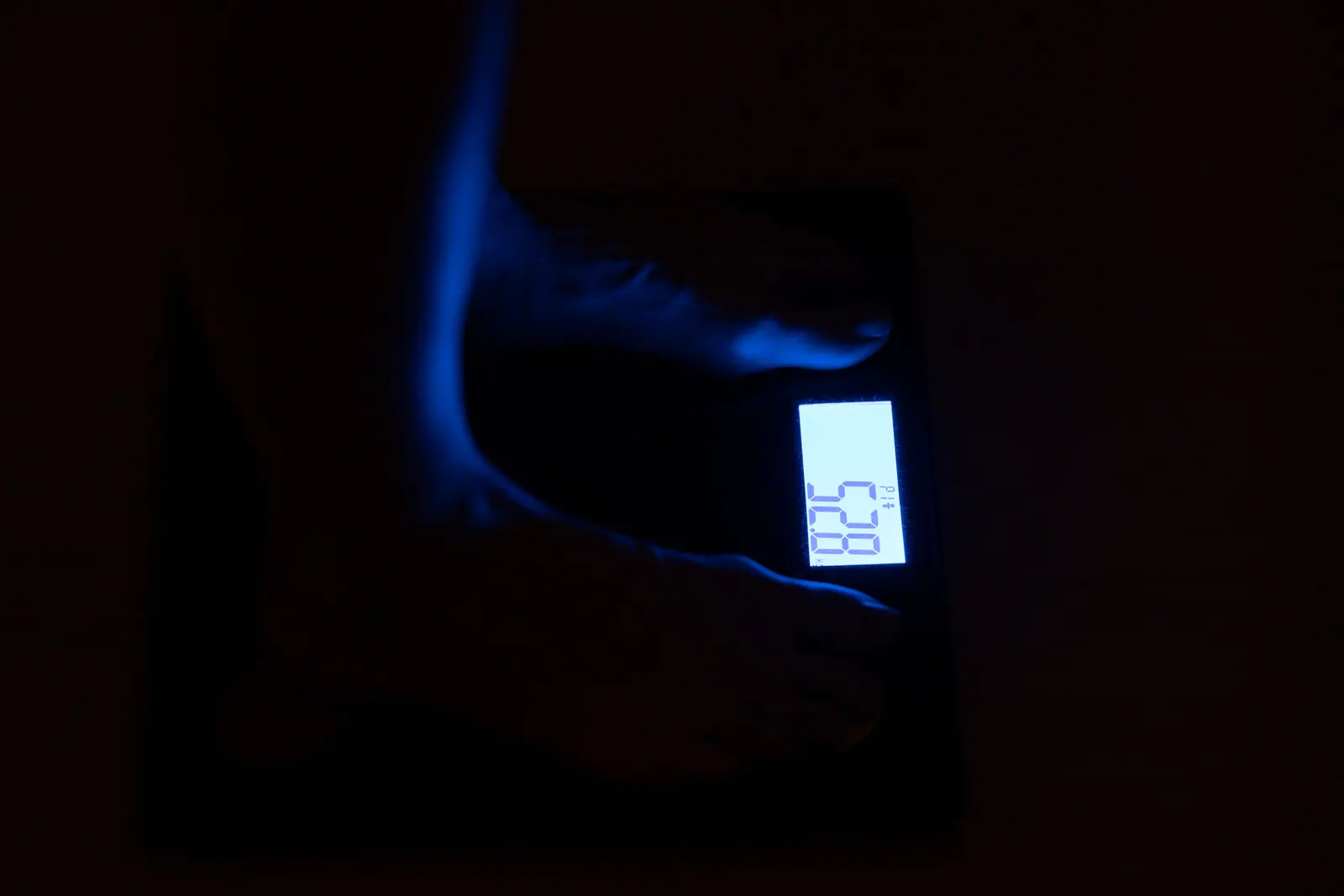
Use one scale and the correct user profile, following that model's instructions. For example, Withings' Body Cardio guidance specifies a hard, flat surface, bare feet, a still posture and comparable measurement conditions. Its suggested timing includes shortly after waking, before eating or drinking.
A practical record might therefore use comparable mornings before breakfast, with the scale in the same position. Record unusual circumstances such as illness, a hard recent workout or a change in routine. This helps identify readings that may not be directly comparable; it does not validate the device's fat or muscle estimates.
Do not skip needed medicines, restrict fluid deliberately or invent progressively stricter preparation rules to control the result. Follow clinical advice where it applies. If frequent checking makes you anxious, reducing or stopping the routine may be more useful than collecting more data.
Mark a device change clearly. Start a new series labelled with the new model or service instead of silently joining it to six months of another instrument's readings. Preserve original reports, including units and available device details, rather than keeping only a screenshot of the headline percentage.
Is the scale actually measuring your fat?
An ordinary scale measures the load placed on it. A smart scale's body-composition display requires additional measurements and calculations. Many use bioelectrical impedance analysis, or BIA: electrodes measure the body's electrical properties, which feed into equations estimating its composition.
A 2026 expert report explains that these electrical properties depend strongly on the amount and distribution of water. Equations also depend on the device and the population used to develop them. The fat number is therefore an estimate, not fat being weighed separately inside your body.
Food and fluid intake, exercise and altered fluid balance can affect results. Standardising preparation can reduce variation, but it cannot remove every systematic error in an equation. Follow the device's safety instructions, including restrictions concerning implanted cardiac devices; do not deliberately dehydrate yourself to produce a more flattering reading.
This distinction explains why a scale can weigh you reasonably well while being less accurate about your fat mass. The weight, fat and muscle figures may appear together in the app, but they do not have the same measurement process behind them.
Compare the method as well as the number
Body-fat scale
Estimates body composition using its measurement and algorithm.
DEXA
Uses a different method; its result is not interchangeable.
What DXA does differently
DXA and DEXA both refer to dual-energy X-ray absorptiometry. The expert report describes a scanner using two X-ray energy levels. Differences in absorption allow it to estimate bone mineral, fat mass and lean soft tissue, for the whole body or particular regions.
It provides a different kind of measurement from a bathroom scale's electrical reading. It still needs appropriate positioning, analysis and preparation. Calling DXA a reference method in a comparison does not mean every number it produces is error-free or directly interchangeable with a different scanner's output.
Check what appointment you are buying or being referred for. A bone-density report answers a different question from a whole-body composition report. Ask which measurements the service will provide and what decision they are intended to inform before arranging repeat scans just to collect another percentage.
Does a change in lean mass mean muscle gained or lost?
The GLIS research glossary defines soft-tissue lean mass as the non-fat, non-bone component, including muscle, organs, connective tissue and water. Fat-free mass also includes bone. These terms should not be substituted casually for skeletal muscle.
A change in a lean-mass estimate is consequently not a direct measurement of the same change in muscle. Nor does it tell you how strong you are. If a report uses the label 'muscle mass', ask whether it is a device estimate and what the calculation represents.
This matters during training or weight loss. A small movement in an app's muscle number should not automatically overrule several weeks of improved performance, or reassure you when strength and function are deteriorating. Our guide to preserving muscle during weight loss explains why composition and capability need to be considered together.
Why can body-fat percentage fall without fat loss?
Body-fat percentage is estimated fat mass divided by total body mass. Both parts matter. In a fictional example, 20 kg of fat in an 80 kg body gives 25%. If fat stayed at 20 kg while total mass became 82 kg, the percentage would be about 24.4%.
The percentage fell without any fat reduction in that calculation. On a real report, check estimated fat mass in kilograms as well as the percentage and total weight. The estimate has uncertainty, but the distinction stops a change in the denominator being mistaken for a measured amount of fat lost.
Also distinguish percentage points from a percentage change. Moving from 25% to 24% is a fall of one percentage point, or a 4% reduction relative to the original 25%. A report saying only 'down 1%' can leave the comparison unclear.
How far out were consumer scales in a study?
A 2021 hospital study compared three smart-scale models with DXA at the same visit. There were 53 patients tested on the Téfal Body Partner, 52 on the Terraillon DietPack and 48 on the Withings Body Cardio. Participants had been referred because of obesity or chronic conditions affecting body composition.
For the Withings model, the median fat-mass estimate was 3.7 kg below DXA. The middle half of differences ran from 8 kg below to 0.3 kg above. That range is an interquartile range, not the limits containing every result. Its median weight difference, by contrast, was only about a quarter of a kilogram.
The other two models also tended to underestimate fat mass. These results do not provide a correction for your own scale: adding 3.7 kg would ignore the variation between individuals, devices and populations. They show why reasonable weighing performance does not validate the body-fat estimate beside it.
Why a small average error can hide a large personal error
A 2026 study compared DXA, Tanita bioimpedance and a three-dimensional optical scanner in 44 healthy women aged 40–65. In its body-fat comparison, the average DXA reading was about 3.2 percentage points higher than BIA. The published 95% limits of agreement ran from roughly 2.7 points lower to 9.0 points higher.
Those limits describe the spread of individual differences, not uncertainty around the average. A modest average gap therefore did not mean the methods agreed closely for each woman. The results concern those devices and that sample, rather than every scanner or person.
The study was funded by Pharmalink International; the authors reported no funder involvement in analysis or manuscript preparation. Several measurements were repeatable, but the authors cautioned against treating the methods as interchangeable for individuals. Repeatability is useful, but it answers a different question from agreement.
Imagine two fictional devices that repeatedly give 27% and 30%. Each may be consistent with itself. Averaging them to 28.5% does not establish a truer answer, and switching between them can create a jump in a graph that looks like a bodily change.
How large must a DXA change be to count?
Ask the service for its precision and the least significant change for the particular measurement. This is a threshold used to distinguish change from measurement variation at a stated confidence level. It is not the smallest number the scanner can display, and a statistically detectable change is not automatically clinically important.
The International Society for Clinical Densitometry requires assessment of precision and consistent preparation for body-composition scans. Relevant details include positioning, clothing, fasting state, time of day, recent activity and an empty bladder. Comparisons across equipment also require attention to calibration.
For an explicitly hypothetical example, suppose a service's appropriate fat-mass precision error is 0.5 kg. Using the 95% least-significant-change calculation applied in the 2026 comparison, multiplying by 2.77 gives about 1.4 kg. A 0.3 kg difference would be below that example's threshold.
Do not adopt 1.4 kg as your personal rule. The service must establish the relevant precision, and same-day technical repeatability does not capture every biological difference between days. Ask: 'Is this change larger than the uncertainty for these comparable scans?' rather than interpreting every decimal as progress or failure.
Pregnancy is a contraindication to DXA body-composition scanning in the ISCD positions. Tell the service if you are pregnant or could be pregnant before booking. If a clinician requested the scan, discuss its purpose and the follow-up plan with them.
Would another measurement change what you do?
If the question concerns central body size and health risk, our waist-to-height guide explains that measurement alongside BMI. If the question concerns strength training, exercise, repetition and resistance records describe performance that a fat percentage cannot measure.
Before paying for repeated scans, ask what a different result would change. A clinically supervised intervention may have a clear measurement plan; curiosity about a single decimal may not. Use the result beside the relevant symptoms, function and clinical advice, rather than choosing whichever device gives the most flattering or alarming number.
The NHS eating-disorders overview lists spending a lot of time worrying about weight and shape among possible symptoms, and advises seeing a GP promptly if you think you may have an eating disorder. Another body scan is not a substitute for getting help with those concerns.