Weight loss and physical function
How to protect muscle and strength during weight loss
On this page
The scales can show progress while your training log tells a different story. If your weight is falling but the same stairs or exercises are getting harder, it is worth looking beyond the number you lost.
Weight loss can include lean tissue. In older-adult trials, resistance-containing exercise limited that loss while improving function. Strength training, adequate eating and monitoring capability belong alongside the weigh-in.
This guide concerns intentional weight management. If weight keeps falling without a change in diet or activity, NHS advice is to see a GP, promptly if other symptoms accompany it. Unexplained loss needs investigating rather than a new exercise target.
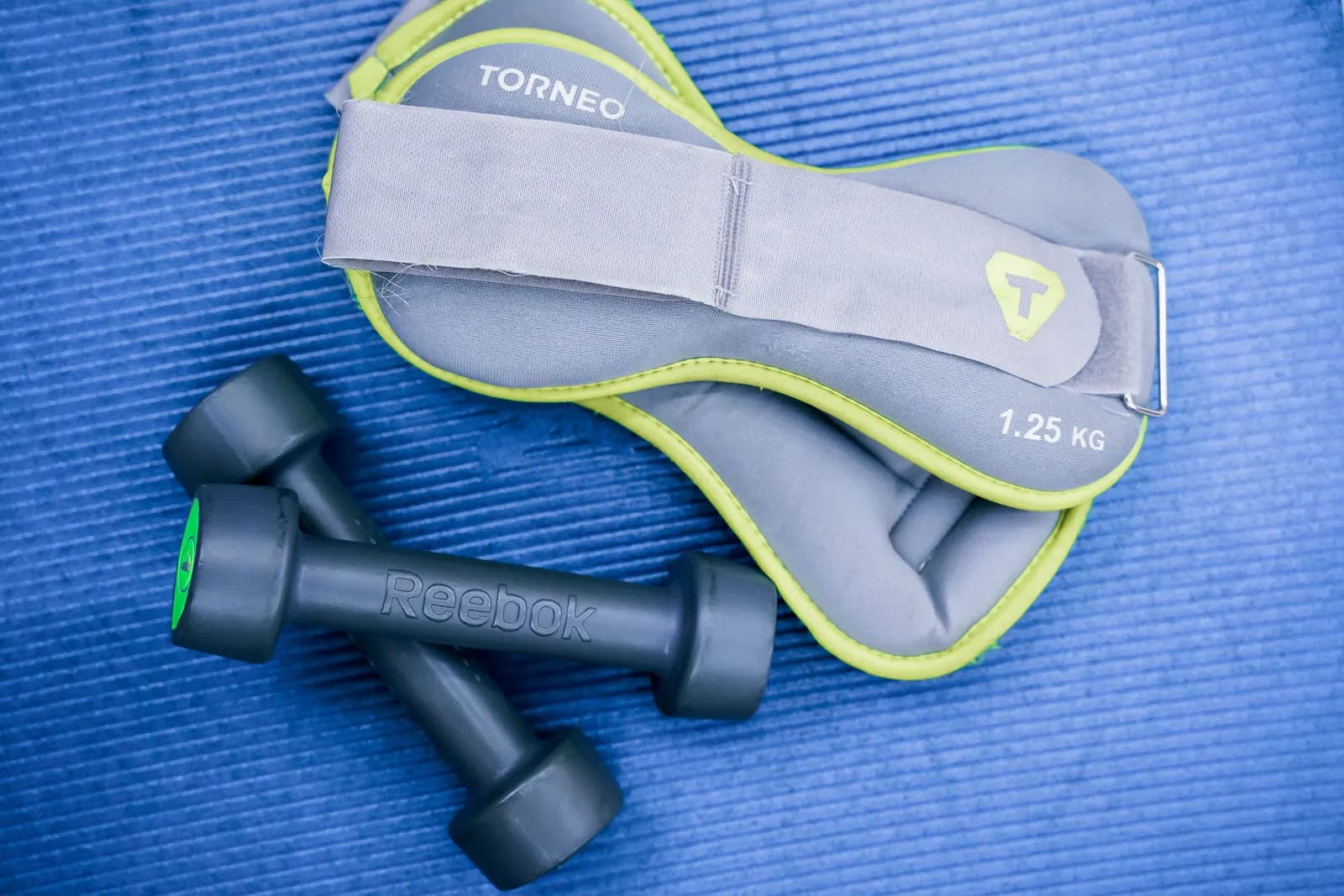
Keep strength work in the week
The 2026 American College of Sports Medicine position stand supports resistance training at least twice weekly, using at least two sets and enough effort. Around two or three repetitions left in reserve is a way to describe adequate effort without taking every set to failure. This is general adult training guidance, separate from the higher-volume weight-loss trials discussed later.
'Repetitions in reserve' means the extra repetitions you think you could complete with the same technique before having to stop. If you finish a set and could comfortably do many more, it was relatively easy. If another repetition would require heaving or losing control, you have gone much closer to your limit.
For a beginner, our two-day strength routine provides movements and instructions that can fit a home setting. Start with versions you can perform comfortably and learn their setup before increasing difficulty. A gym programme can use machines or weights; choose equipment you can use consistently and confidently.
A simple planning example is strength work on Monday and Thursday, with your usual walking or other aerobic activity around it. Choose days that fit your week. If you already train regularly, first preserve a workable version of the programme rather than adding sessions simply because you have started losing weight.
Record a starting session. If you later change the exercise, equipment or range, note it; a heavier weight with a much shorter movement is a different comparison. Our progressive-overload guide explains how to adjust repetitions and resistance in small, understandable steps.
Where frailty, injury or a medical condition affects exercise, seek an appropriate assessment. The supervised trials should not be used as a reason to jump directly to their heavier training loads. Existing rehabilitation advice takes priority over a general online programme.
Plan enough food and discuss a suitable protein target
A recent expert consensus on care during GLP-1-based weight loss proposes 1.2–1.5 g protein per kilogram of actual body weight per day. The authors label this an expert-opinion recommendation, rather than a trial-established optimum. Nestlé Health Science supported the project and panel honoraria.
For arithmetic only, an 80 kg body weight multiplied by that range gives 96–120 g daily. But the consensus acknowledges that actual-weight calculations may overestimate requirements when fat mass is high. It discusses other approaches, including adjusted or reference weights; there is no single settled calculation for every person with obesity. Do not quietly substitute a different weight while treating the result as the same recommendation.
The recommended range differs from the protein intake in the older exercise trials discussed later. A target should help organise adequate eating; it does not make a supplement mandatory. Use the calculation alongside an account of what you actually eat and any difficulty meeting your needs.
Kidney disease is a specific reason to get individual dietary advice. Northern Care Alliance NHS guidance explains that needs depend on the stage of disease, treatment and nutritional circumstances. Too little protein can also be a problem; do not assume all kidney patients should restrict it or adopt a higher range independently.
To make your intake easier to assess, record an ordinary day's meals and portions. Where a label gives protein per 100 g, use the amount you actually eat. A fictional food containing 10 g per 100 g would provide 15 g in a 150 g portion. Add the contributions across the day before deciding there is a gap to fill.
Our protein guide covers the wider recommendations, and the breakfast examples show how to compare foods. Use foods you enjoy and can prepare. If appetite is low, a long list of ambitious meals is less useful than identifying which ordinary meals you can currently manage.
Look beyond the number on the scale
Body weight
Shows the total change, not which tissue changed.
Strength and function
Show how your body performs everyday and training tasks.
Does lean-mass loss mean muscle loss?
The Global Leadership Initiative in Sarcopenia glossary explains that DXA lean soft tissue includes water, organs and connective tissue as well as muscle. Fat-free mass additionally includes bone. Check the category a study actually reports before translating it into 'muscle lost'.
For example, a headline saying somebody lost three kilograms of muscle may be based on a three-kilogram change in lean mass. Those statements are not interchangeable. Nor does the composition result, by itself, say how much strength changed. Strength and everyday performance need their own observations.
Our body-fat scales and DXA guide explains the measurement differences. Before paying for another scan or reacting to a home-scale reading, ask what decision it would change. A repeat measurement is most useful when its method and interpretation are clear.
Keep a familiar lift in your record: the weight or band, repetitions, range of movement and whether the last repetitions remained controlled. Also notice a routine task such as your usual stairs or carrying the same shopping bags. A sustained deterioration gives you something concrete to investigate; neither observation requires buying a body-composition device.
How much difference did exercise make in weight-loss trials?
In a 2017 trial, 160 sedentary adults aged 65 or older with obesity and mild-to-moderate frailty were assigned to control or weight management with aerobic exercise, resistance exercise, or both. The intervention included weekly dietitian support, a 500–750 calorie daily deficit and about 1 g protein per kilogram of body weight daily. Intervention groups lost about 9% of body weight over six months.
Exercise was supervised three times weekly. Aerobic-only and resistance-only sessions lasted around an hour; combined sessions took 75–90 minutes, including 30–40 minutes of each type. Resistance training used nine upper- and lower-body machine exercises with progressively increased loading. Calcium and vitamin D were also provided.
Physical Performance Test scores improved by 21% with combined training and 14% with either single exercise type. Lean mass fell by 3% with combined training, 2% with resistance and 5% with aerobic exercise. The combined programme therefore improved function most while preserving more lean tissue than aerobic training alone. It also took longer: this was not an equal-time comparison. Musculoskeletal injuries occurred.
An earlier, year-long trial in 107 similarly selected older adults included a diet-only group. Diet plus exercise produced about 9% weight loss and 3% lean-mass loss; diet alone produced about 10% and 5%, respectively. The combined programme improved physical performance most. Its supervised exercise sessions lasted around 90 minutes, three times weekly, combining aerobic work, resistance, flexibility and balance.
The Physical Performance Test assessed tasks including chair rising, walking, turning, stairs and lifting a book. This helps explain why the result matters: success included doing things better, even though some lean tissue was lost. These were substantial supervised programmes in older adults; their exact schedules are evidence about what was studied, not a starting prescription for everyone.
What changes when you take a weight-loss medicine?
The 2025 SURMOUNT-1 DXA substudy analysed paired scans from 160 people without type 2 diabetes: 124 received tirzepatide and 36 placebo. Over 72 weeks, body weight fell by 21.3% and 5.3%, respectively; lean mass fell by 10.9% and 2.6%. About 26% of the weight lost with tirzepatide was lean mass, compared with 25% with placebo.
Those percentages answer different questions. A 10.9% reduction describes change from the starting lean-mass amount; 26% describes the share of total weight loss made up of lean tissue. Neither means 26% of all starting muscle disappeared.
The substudy included lifestyle counselling but no specified strength-training protocol. It did not directly test physical performance or whether adding resistance training prevented the composition change. It was a selected, relatively small substudy funded by Eli Lilly, which participated in the work. The result provides useful context for care, not a measurement of how much strength any individual will lose.
Our guide to nutrient monitoring while taking a GLP-1 discusses reduced intake and reviewing concerns with a GP or prescriber. Blood tests do not measure muscle strength. If you use a prescribed medicine, tell the prescriber when reduced appetite, nausea or another difficulty is stopping you from eating adequately. Bring a day's actual intake and your exercise observations. Do not alter the dose in response to a body-fat scale or use the falling weight as a reason to leave persistent difficulties unmentioned.
Review what you can do alongside what you weigh
You can keep this manageable with one short record: weight trend, usual meals, strength sessions and any difficulty with ordinary activities. A useful fictional note is, 'Weight is falling, but I regularly miss lunch and have reduced two exercises because I feel weak.' It identifies what needs attention much better than the weight number alone.
Compare familiar tasks under similar conditions. One poor session after an illness or a disrupted night is different from a continuing decline across ordinary weeks. Write down the circumstances so you can discuss the pattern without having to guess its cause.
Persistent weakness, worsening everyday function or ongoing difficulty meeting food needs warrants a clinical conversation. If you are managing weight independently, a GP or registered dietitian can help assess those concerns; you do not need an existing coaching package to ask for help.
For this week, choose the strength sessions you can actually attend, identify the meals most likely to be missed and write down one familiar exercise to follow. Bring that record to your next review, especially if eating or everyday activity has become harder.