Fermented foods
Fermented foods for gut health: what to choose and expect
On this page
Sourdough, kimchi and live yoghurt can all be fermented foods. They are not interchangeable ways to get living microbes, and a longer list of cultures does not tell you which will help your digestion. The useful question is what you want from the food you are buying.
Live yoghurt has a specific, well-supported benefit: its cultures can help people who struggle to digest lactose digest the lactose in that product. Broader claims about fermented foods improving 'gut health' need more careful unpacking. A change in gut bacteria is interesting, but it does not by itself show that a person feels better or has a lower disease risk.
For shopping, start with two questions: was the food made by fermentation, and does it still contain living microbes when you eat it? Yoghurt, baked sourdough and cooked tempeh can all be fermented foods while giving different answers to the second question.
Which foods still contain live cultures?
The ISAPP fermented-food resource distinguishes foods retaining live microbes from those processed after fermentation. Here is how that applies to common purchases:
- Yoghurt and milk kefir can contain live cultures. Look for confirmation on the product. Kefir uses a broader mixture of bacteria and yeasts; a longer microbial list does not establish a better clinical result.
- Kimchi and sauerkraut can contain live microbes when they have not been heat-treated after fermentation. Pasteurised or otherwise heat-treated versions remain fermented foods, but are not equivalent live-culture sources.
- Kombucha varies. Check whether the finished drink has been pasteurised or filtered and whether the manufacturer confirms living cultures.
- Miso and tempeh may contain living microbes before cooking, depending on processing. Heating the final dish changes that exposure; cook tempeh as directed rather than eating it raw to preserve cultures.
- Sourdough bread is baked after fermentation. It is a fermented food, not a reliable way of delivering the original living starter microbes.
Stanford's food-identification guidance treats refrigeration as a clue. The label and manufacturer's processing information are more specific. A chilled location does not prove a probiotic benefit, and shelf location alone cannot tell you everything done to a product.
Ordinary pickling in vinegar is also different from microbial fermentation. Some products undergo both, so a vinegar ingredient alone cannot settle the question. If the label leaves the process unclear, treat the live-culture status as unknown rather than inferring it from a sour taste.
Does fermented mean probiotic?
The ISAPP scientific consensus defines fermented foods by the desired growth of microbes and the changes their enzymes make to food components. Living microbes need not remain in the final food. 'Probiotic' adds another requirement: identified living microorganisms, in adequate amounts, with a demonstrated health benefit. A long list of culture names alone does not supply that evidence.
Think of the first description as how the food was made, the second as what is still present, and the third as a claim requiring a suitable human result. These are useful distinctions when a front-of-pack message combines all three into a general promise.
Fermented does not automatically mean probiotic
Fermented food
Made using microorganisms; products vary.
A probiotic claim
Needs evidence about the particular organisms and benefit.
Can pasteurised yoghurt contain live cultures?
The order matters. Milk can be pasteurised first and then fermented with living starter cultures. The resulting yoghurt can therefore be both made from pasteurised milk and contain live cultures, as Stanford's guidance explains. Heating a finished yoghurt after fermentation is a different sequence.
This distinction is particularly useful in pregnancy. The NHS lists pasteurised yoghurt as safe and advises avoiding unpasteurised milk and yoghurt. Seeking living cultures is not a reason to choose raw milk. Check what the product actually says about its milk and cultures.
Check the salt, sugars and portion too
Fermented vegetables and sauces can contribute substantial salt. One real example is Biona Organic Sauerkraut, whose label lists 1.66 g salt per 100 g. A 25 g portion supplies about 0.42 g; 50 g supplies about 0.83 g. Those are calculations for that product, not universal values or a recommended daily serving.
A condiment-sized amount and a large bowl have different nutritional contributions even when both are described as 'having sauerkraut'. You can weigh your usual amount once to understand the label without turning every meal into a calculation. Compare another product on the same per-100-g basis, then consider the portion you would actually use.
For yoghurt and kefir, compare protein, sugars and ingredients separately from the cultures statement. A food can contain living microbes and still have a composition that differs considerably from the next pot. The question is what the whole food contributes to the meal.
Choose something you will actually eat
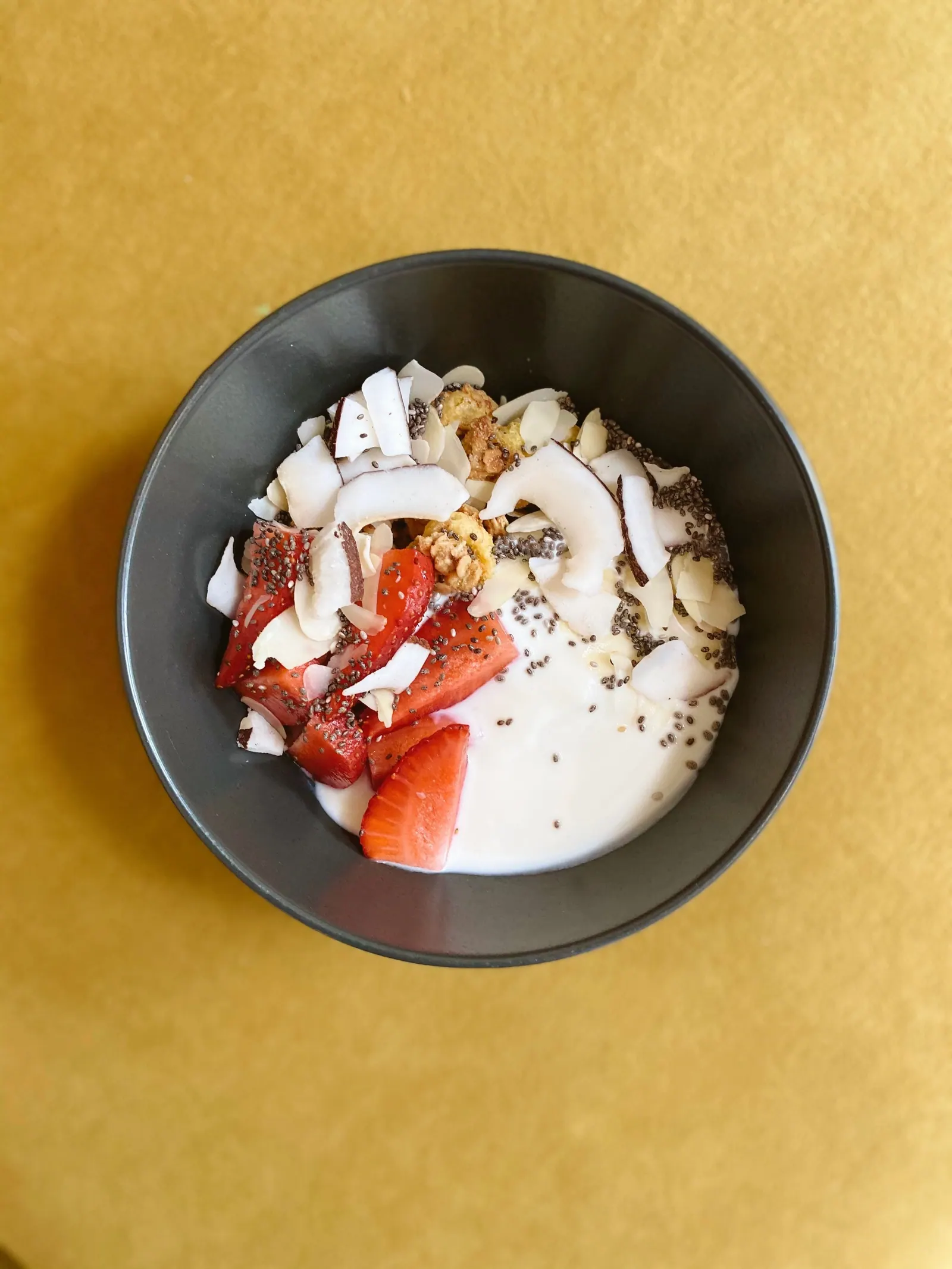
If you already eat oats, plain live yoghurt can be a straightforward addition with fruit. If you prefer a drink, kefir may fit better. Choose the amount as food within your meal, rather than copying a trial's intake as though it were a treatment dose.
For a savoury meal, a small amount of fermented vegetables can add a sharp flavour beside rice and a protein source. Taste it before adding other salty seasonings. You can adjust the combination while keeping track of the product's salt contribution.
Tempeh can serve as a main ingredient rather than a condiment. Our plant-protein meal guide gives an actual tempeh protein value and a worked lentil-and-tempeh meal. Its nutritional role does not depend on claiming that cooked tempeh delivers living microbes.
If you are trying a food because of a symptom, change one thing at a time and note the amount and the symptom that matters. A useful record says what happened to bloating, discomfort or bowel habits; it does not need an invented gut-health score. Persistent or worsening symptoms need assessment rather than another succession of products.
Why might yoghurt be easier to digest than milk?
Lactose is the sugar in milk. The official European scientific-claim entry for live yoghurt cultures concerns improved digestion of the product's lactose in people who have difficulty digesting it. Its conditions specify sufficient amounts of the two standard live yoghurt starter organisms. That is a defined food-digestion effect, not a promise that every fermented product treats digestive symptoms.
The cultures can supply lactase, the enzyme that breaks down lactose, as the ISAPP consensus explains. In an early human experiment, yoghurt containing 18 g lactose produced about a third of the breath-hydrogen response to the same lactose load in milk or water among lactase-deficient participants, with fewer reported symptoms. Breath hydrogen was used to assess what happened to the lactose.
This can help explain why some people tolerate yoghurt differently from milk. It does not establish a cure for lactose intolerance or make dairy suitable for someone with a milk allergy, which is a different problem. The effect is tied to the food and living cultures, not permanent installation of bacteria in the gut.
Kefir also has relevant human evidence, but less reason for sweeping superiority claims. A small 2003 trial tested 15 adults with lactose maldigestion using meals containing 20 g lactose. Plain kefir and plain yoghurt produced lower breath-hydrogen responses than milk over eight hours; flavoured kefir was intermediate. That short experiment does not show kefir is better than yoghurt or that either treats IBS.
What about the study showing more diverse gut bacteria?
A 2021 Cell study analysed 36 healthy adults, with 18 in a high-fibre group and 18 in a high-fermented-food group. Two participants requested the fibre assignment. The seventeen-week protocol included a ten-week diet phase. Fermented-food intake rose from about 0.4 to 6.3 daily servings on average, including yoghurt, kefir, fermented vegetables and other products.
Gut microbial diversity increased in the fermented-food group, and 19 of 93 measured immune or inflammatory proteins fell. These are positive biological findings worth investigating. The study had no usual-diet control arm, involved few people, and measured biological outcomes rather than disease prevention or longer life. It also could not identify one supermarket product as responsible.
The six-serving figure describes an intensive research intervention, not a recommended dose for your shopping list. Mild bloating increased while intake was being raised, then was no longer significantly higher during maintenance. More food and more microbial species are not automatically better for every person.
The fibre arm addressed a different dietary change. For practical food quantities, our high-fibre food guide covers oats, pulses, bread and vegetables. These can sit alongside fermented foods in meals without requiring a choice between two diet labels.
More bacteria did not always mean better health
A 2026 yoghurt-and-oats trial randomised 119 healthy adults to the order of two interventions; 110 completed the study. Participants consumed 250 g yoghurt daily, either alone or with 50 g rolled oats, for four weeks per intervention with washout periods.
Yoghurt-associated bacteria increased temporarily, returning towards baseline after washout. Neither intervention significantly changed the measured health markers or faecal short-chain fatty acids. An oats-related change in microbial evenness appeared in a subgroup of only eight people. The trial was unblinded and had no precise formal power calculation; no funding or conflicts were declared.
Finding more of a bacterium therefore did not establish that the participants became healthier. When reading a headline about the microbiome, look for the outcome after the bacterial measurement: symptoms, everyday function, a disease event, or only another laboratory result. That helps you judge what the study actually adds to a food choice.
Should you buy a probiotic supplement instead?
The NHS probiotics guidance explains that an effect for one type of probiotic and one problem does not establish the same benefit for other products or conditions. It advises speaking to a doctor before supplements if you have an existing health condition or weakened immune system.
Before paying for a supplement, ask which exact microorganisms were tested, at what amount, in whom and with what result. For the next food purchase, a simpler decision is available: choose a product you can use in a named meal, check whether its cultures are live if that matters to you, and compare its ordinary nutrition label too.