Food for training
Plant protein and strength training: how to make meals work
On this page
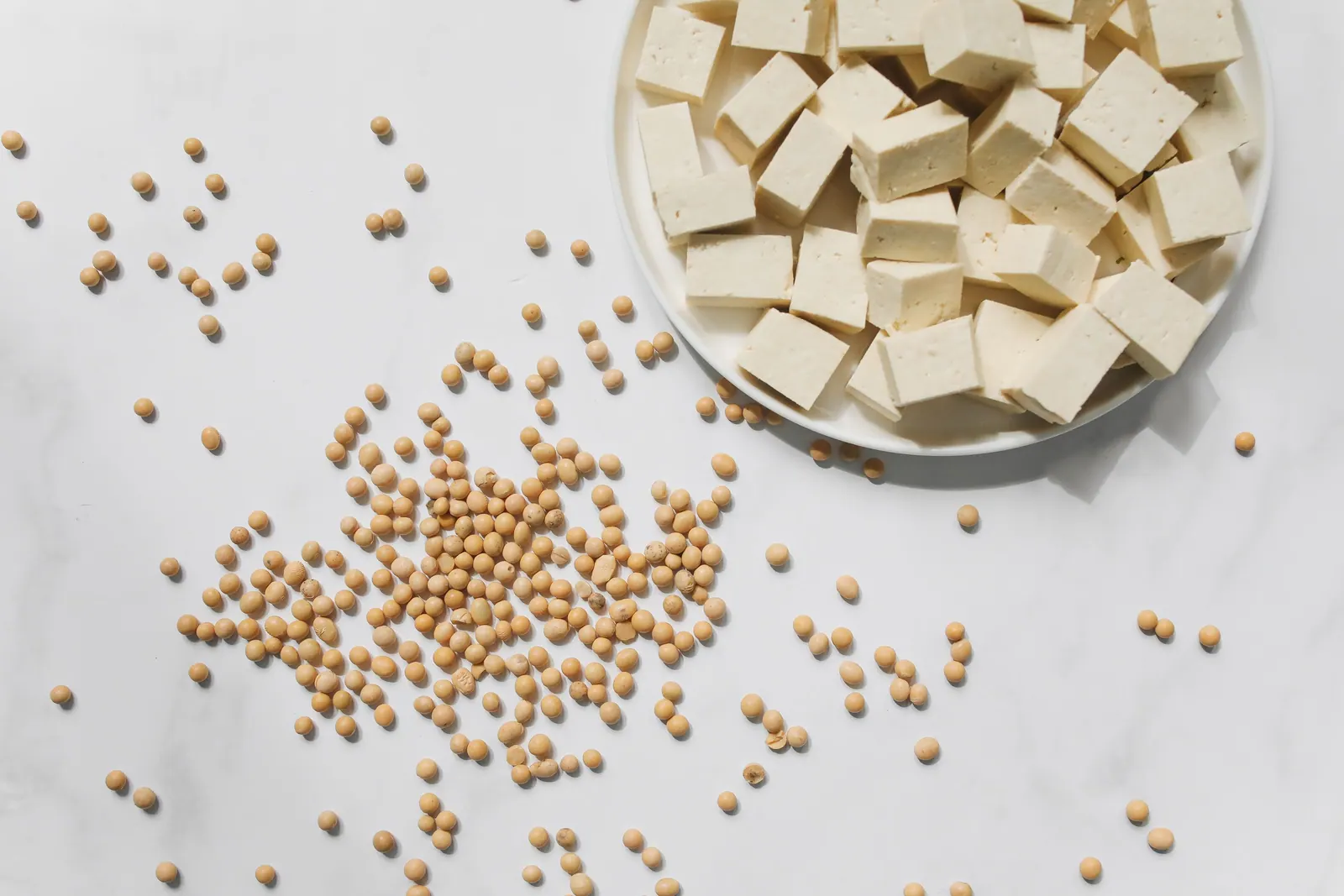
Take the chicken out of your usual stir-fry and you still have dinner. But what is doing its job now? A substantial portion of tofu and a few beans scattered over the vegetables provide very different amounts of protein.
A plant-based diet can support strength training. What matters is replacing the protein and energy supplied by the foods you remove, rather than simply taking meat off the plate.
Start with the portions on your plate, then use the research to understand where the approach works and where it needs more care. You do not need to turn every meal into an amino-acid calculation.
How much protein is in an ordinary portion?
Here are current UK product examples, checked in October 2026. They are reference points, not endorsements or averages for every tofu, bean or drink. Figures are rounded from the named products' nutrition tables; check your own pack because recipes and labels change.
- Naked Tofoo lists 16.5 g protein per 100 g. A 150 g portion before cooking supplies about 25 g.
- Better Nature Original Tempeh lists 22 g per 100 g. A 100 g portion before cooking supplies 22 g.
- Tesco Green Lentils in Water list 7 g per 100 g drained. A 150 g drained portion supplies about 11 g.
- Tesco Red Kidney Beans list 6.8 g per 100 g drained. A 150 g drained portion supplies about 10 g.
- A 250 ml glass of Alpro Soya No Sugars supplies about 8 g, compared with 2 g from the same volume of Alpro Oat Original. Those products list 3.3 g and 0.8 g per 100 ml respectively.
Drained weight matters. The lentil tin above has a net weight of 390 g but contains 235 g of drained lentils; the kidney-bean tin is 400 g with 240 g drained. Counting the water as beans would substantially overestimate the protein you eat. Dry pulses are another comparison again: do not apply a dry-food value to a cooked serving.
The drink comparison is useful if you are replacing milk at breakfast. Choosing a plant alternative by colour or the word 'barista' will not tell you its protein content. Check protein and fortification separately: they answer different nutritional questions.
Two meals you can put together
For a tofu bowl, use 150 g of the named tofu per person, prepared according to the packet, with rice and cooked vegetables. The tofu alone supplies about 25 g protein. Rice and vegetables add their own contribution, but that total depends on the type and amount you serve. Use your rice and vegetable portions if you want to calculate the whole bowl.
For two people, start with 300 g tofu rather than assuming one small pack will provide the intended portions. Add a sauce you like and enough of the other foods to make a satisfying meal. Keep this combination in mind when shopping: the important change from a vegetable-only stir-fry is an actual quantity of a protein source.
Alternatively, make a two-person tomato stew using 300 g drained lentils and 200 g of the named tempeh, with onion, tomatoes and seasoning. Each portion contains 150 g lentils and 100 g tempeh, supplying about 33 g protein from those two ingredients. Serve with bread or potatoes if that suits the meal. Follow the tempeh's cooking directions.
Count the substantial ingredients and divide by the number of portions you actually serve. If the same stew becomes three portions, each gets about 22 g from the lentils and tempeh. Dividing a recipe into more servings changes what a serving provides.
Make the protein part of the meal clear
- 1
Choose a protein food
Build around beans, lentils, tofu or other suitable foods.
- 2
Plan the whole day
Think about the amount across your usual meals.
- 3
Combine with training
Keep track of the strength work you actually do.
Can plant-based diets support the same training gains?
A 2021 study followed 38 previously untrained young men who were already habitual vegans or omnivores. They completed twelve weeks of supervised resistance training, with protein adjusted to about 1.6 g per kilogram of body weight daily. Soy supplements helped the vegan group reach that intake; whey did the same for the omnivorous group.
Both groups gained strength and muscle measures, without significant differences between groups. This was a useful test of adequately supplied diets, although participants were not randomly assigned to their longstanding eating pattern. It was also a study of young men using supplements, rather than a comparison of every possible plant-based menu.
For someone weighing 70 kg, the study's 1.6 g/kg/day works out as 112 g of protein across the day. That means grams of the nutrient, not 112 g of tofu or beans. The distinction matters because foods contain water, carbohydrate, fat and other components as well as protein.
Do you need to worry about amino acids?
Protein is made from amino acids. Some are essential: the body needs a dietary supply. The British Dietetic Association explains that protein quality depends on both the amino-acid pattern and digestibility. Two foods with the same number of protein grams need not supply the same amounts of each essential amino acid after digestion.
Plants vary. Cereals tend to supply relatively less lysine, while other foods can complement that pattern. A varied day's eating is useful; you do not have to arrange a perfect cereal-and-pulse combination at every meal. A lentil lunch and a grain-based breakfast can contribute to the same day's diet.
A laboratory analysis of protein powders found more lysine in soy and pea proteins than in wheat and rice proteins. Corn protein was relatively rich in leucine but low in lysine. Those are measurements of particular isolates, not proof that one ordinary food wins every nutritional comparison.
Leucine helps signal muscle protein synthesis, the process of making muscle protein. Human experiments have examined how that signal differs with age. But the other essential amino acids still provide building material. Buying leucine alone does not replace an adequate diet or establish a long-term strength benefit.
Digestion also depends on the food and its processing. The FAO's protein-quality report distinguishes amino acids available after digestion from their subsequent use in the body, which also depends on energy and other needs. A digestion score is therefore not a score for your whole diet or your next gym session.
These differences justify attention to food choice. They do not provide a universal percentage of extra protein that every vegan must eat. The matched-protein training study above is more directly relevant to strength gains than ranking foods by one amino acid alone.
What changes if you are older or have a small appetite?
A 2026 trial randomly assigned 72 adults aged 65 or older to a self-selected vegan diet, their usual omnivorous diet, or a vegan diet with resistance exercise for twelve weeks. Protein intake fell in the vegan groups. Muscle volume and limb lean mass declined more without exercise; training reduced, but did not eliminate, the losses in the vegan-plus-exercise group.
That was not a protein-matched comparison. Its practical warning is about changing a diet and losing nutritional intake along the way, rather than proving that all well-supplied vegan diets cause muscle loss.
The IMPACT trial, published in September 2026, studied 108 adults aged 55 or older receiving dietary counselling and twelve weeks of resistance training. The vegetarian diet included eggs and dairy. Both groups improved muscle mass, leg strength and chair-stand performance, but mean protein intake was lower with the vegetarian diet: about 1.24 versus 1.58 g/kg/day.
The trial did not establish noninferiority for limb muscle mass. That means it did not show the vegetarian approach was no worse than the comparison by more than its specified margin. It is not proof of inferiority, and improvement in both groups is not proof of equivalence. The authors reported no conflicts of interest.
If you have a small appetite, unwanted weight loss or difficulty preparing food, replacing a familiar meal can need more support than swapping its main ingredient. A registered dietitian can help fit nutritional needs to foods you can manage. Kidney disease and other conditions affecting nutrition also warrant individual advice before adopting a high-protein training target.
When does a protein powder make sense?
The food examples show that substantial amounts can come from meals. A powder can still be convenient when an agreed intake is difficult to reach, or when appetite and preparation make another meal impractical. Identify the gap before choosing a product.
Compare grams of protein in the stated serving, ingredients and allergens, then cost per serving. A scoop's total weight is not its protein weight. If you already use one, include it when assessing the day rather than treating it as nutritionally separate from food.
The young-men trial used soy and whey supplements to help match intake. It supports that particular approach, but it cannot tell us how each participant would have managed without the supplements. Nor does a long ingredients list establish that a powder is better than the meals you already enjoy.
Keep the rest of the diet and training in view
The NHS vegan-diet guidance highlights varied foods, fortified products and nutrients including vitamin B12, iodine and calcium. A reliable B12 supply needs deliberate attention through fortified foods and, where needed, supplements. A protein powder is not automatically a source of these nutrients.
Pair the meals with a manageable strength routine and record how the exercises progress. If you are also losing weight, the guide to preserving muscle during weight loss covers why food intake and training need to be considered together.
Begin with one meal you regularly eat. Name its protein source, check what your usual portion supplies, and decide whether a swap leaves a gap. Repeating a meal that works is a more useful starting point than buying several unfamiliar products and hoping the plant-based label has done the planning.