Which free weight exercises should beginners start with?
Five moves, on 2 days a week. A squat, hinge, push, pull and carry cover your whole body. The commonest cause of lifting injuries in US hospital data? A weight dropping on the lifter.
On this page
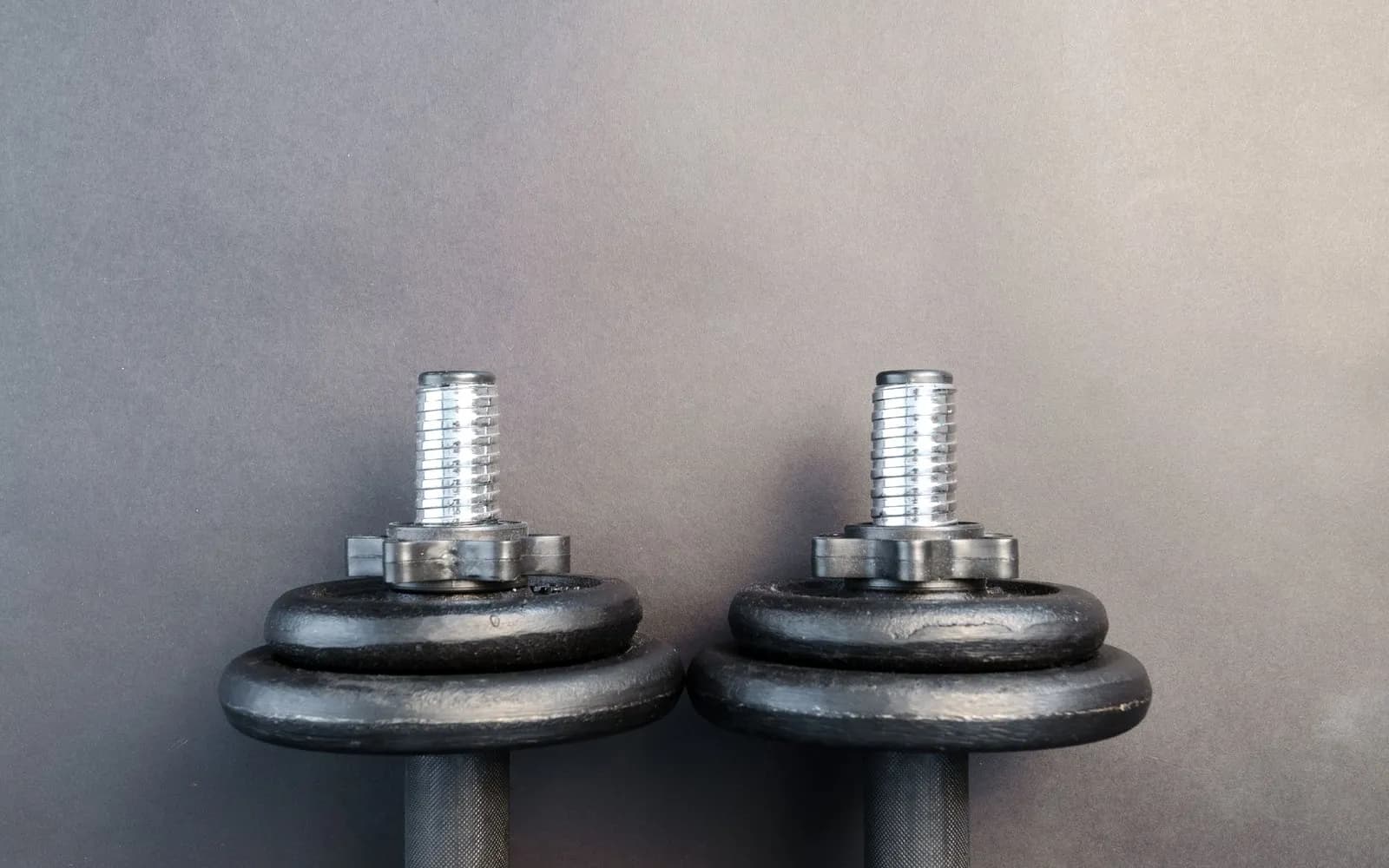
Which free weight exercises should you start with?
Start with one move for each way your body lifts. Coach Dan John names five basic movements: squat, hip hinge (bending at the hips), push, pull and loaded carry.
Together they cover the muscles the NHS lists: legs, hips, back, tummy, chest, shoulders and arms. The UK’s chief medical officers say to work these on at least 2 days a week. They name free weights as one way to do it.
| Movement | Beginner free weight move | Main muscles |
|---|---|---|
| Squat | Goblet squat: squat holding one dumbbell or kettlebell at your chest | Legs and hips |
| Hinge | Romanian deadlift: push your hips back, weights sliding down the front of your legs | Hips, backs of legs, back |
| Push | Dumbbell press: lie on a bench or the floor and push both weights up | Chest, shoulders, arms |
| Pull | One-arm row: one hand on a bench, pull the weight up to your side | Back and arms |
| Carry | Farmer’s carry: walk tall holding a heavy dumbbell in each hand | Grip, shoulders, tummy |
Sources: Dan John via Breaking Muscle; NHS
The moves in each row are our pick. Any free weight move with the same pattern does the same job. Once they feel steady, the same patterns work with a barbell, or a trap bar deadlift for the hinge.
Your next step: try each move with a light dumbbell this week, before you add any sets.
Are free weights better than machines?
No, they work about as well. A review pooled 13 studies of 1,016 adults aged 18 to 60. Each study lasted at least 6 weeks.
| What was measured | Free weights | Machines |
|---|---|---|
| Strength, tested head to head | No clear difference | No clear difference |
| Muscle growth | No clear difference | No clear difference |
| Strength on your own kit | Rose more on free weights | Tended to rise more on machines |
Source: Haugen 2023
The authors say the choice comes down to your preferences and goals. Most people in those studies were men.
An 8-week trial in 38 men who already trained got the same result with barbells. Both groups gained similar strength and muscle, with no extra joint discomfort from free weights.
So pick the kit you’ll keep using, and mix them if you like. Our beginner gym plan uses machines too.
What does a beginner free weight routine look like?
All five moves, 2 to 3 days a week. That’s what the American College of Sports Medicine advises for beginners. It also says to do big moves before small ones.
Pick a weight you can lift 8 to 12 times, and no more. That matches the NHS advice to work to the point where you need a short rest.
Do 2 to 3 sets of each move. A review of 14 studies linked that with 46% bigger strength gains than 1 set.
Your first free weight weeks
- 1
Session 1
All five moves, 2 to 3 sets of 8 to 12 reps (lifts).
- 2
Rest day
Walk or do other activity on the days between.
- 3
Session 2 or 3
The same five moves, in the same order.
- 4
Step up
Can you do 1 or 2 reps more than planned? Add 2 to 10% to the weight.
Sources: ACSM 2009; Krieger 2009; UK CMOs
On a 20 kg goblet squat, 2 to 10% is 0.4 to 2 kg. Our progressive overload guide shows more ways to step up.
Put your 2 or 3 sessions in your diary now.
Are free weights safe for beginners?
The commonest cause of injury in the data is simple. A US study counted lifting injuries treated in hospital emergency departments over 18 years.
| What the study found | Share of injuries |
|---|---|
| A weight dropped on the person | 65.5% |
| Injury happened with free weights | 90.4% |
| Diagnosed as a sprain or strain | 46.1% |
Source: Kerr 2010
That’s the dropped weight from the top. It was the most common cause of injury in the study.
The study counted injuries, not how many people lifted. So it can’t show free weights are riskier per session. Machines had their own pattern: people aged 55 and over had a bigger share of injuries on machines.
So handle the weight between sets with care. Lower it to the floor with control, put dumbbells back on the rack, and keep the floor around you clear.
Are free weight exercises different for women?
No. Use the same five moves and set the weight to suit you.
A review compared women and men on the same programme. They gained similar muscle and lower-body strength. Women’s upper-body strength rose more, relative to where they started.
The studies were short, in young to middle-aged adults. Our guide to strength training for women goes further.
Your free weight starter plan
- Do a squat, hinge, push, pull and carry on at least 2 days a week.
- Do the big moves before the small ones.
- Do 2 to 3 sets of each move.
- Pick a weight you can lift 8 to 12 times, and no more.
- When you can do 1 or 2 reps more than planned, add 2 to 10% to the weight.
- Lower weights to the floor with control and put dumbbells back on the rack.
Sources: UK CMOs; NHS; ACSM 2009; Krieger 2009
When to speak to a GP
The NHS asks some people to speak to a GP first. Book an appointment if:
- You haven’t exercised for some time.
- You have medical conditions or health concerns.
- A sprain or strain is getting worse or not feeling better after treating it yourself.
- Get help from NHS 111 if an injury is very painful or getting worse, or the swelling or bruising is large or getting worse. The same goes if you can’t put weight on it or walk more than a few steps. Or if it feels very stiff or hard to move, or you also feel hot, cold or shivery.
- You’re pregnant and new to weights. The NHS lists gym strength training in pregnancy if you do this already, and says to start new exercise gently. Ask your midwife which activities are safe for you.
Later in pregnancy, the NHS says to avoid lying flat on your back for more than a few minutes. So swap lying presses for a standing overhead press.
After an injury, call 999 or go to A&E if you heard a crack. Or if the body part has changed shape or points at an odd angle. The same goes if it’s numb, tingling or has pins and needles, or the skin is blue, grey or cold.
Call 999 for sudden chest pain or discomfort that doesn’t go away. The same goes for pain that spreads to your arm, neck, jaw, stomach or back. Or chest pain with sweating, feeling sick, light-headed or short of breath.