Building a small home gym: what do you need?
A sturdy chair, a band and dumbbells. They cover the four moves a workout needs. Store them with care: in US hospitals, two in three weight-training injuries came from a weight dropping on the person.
On this page
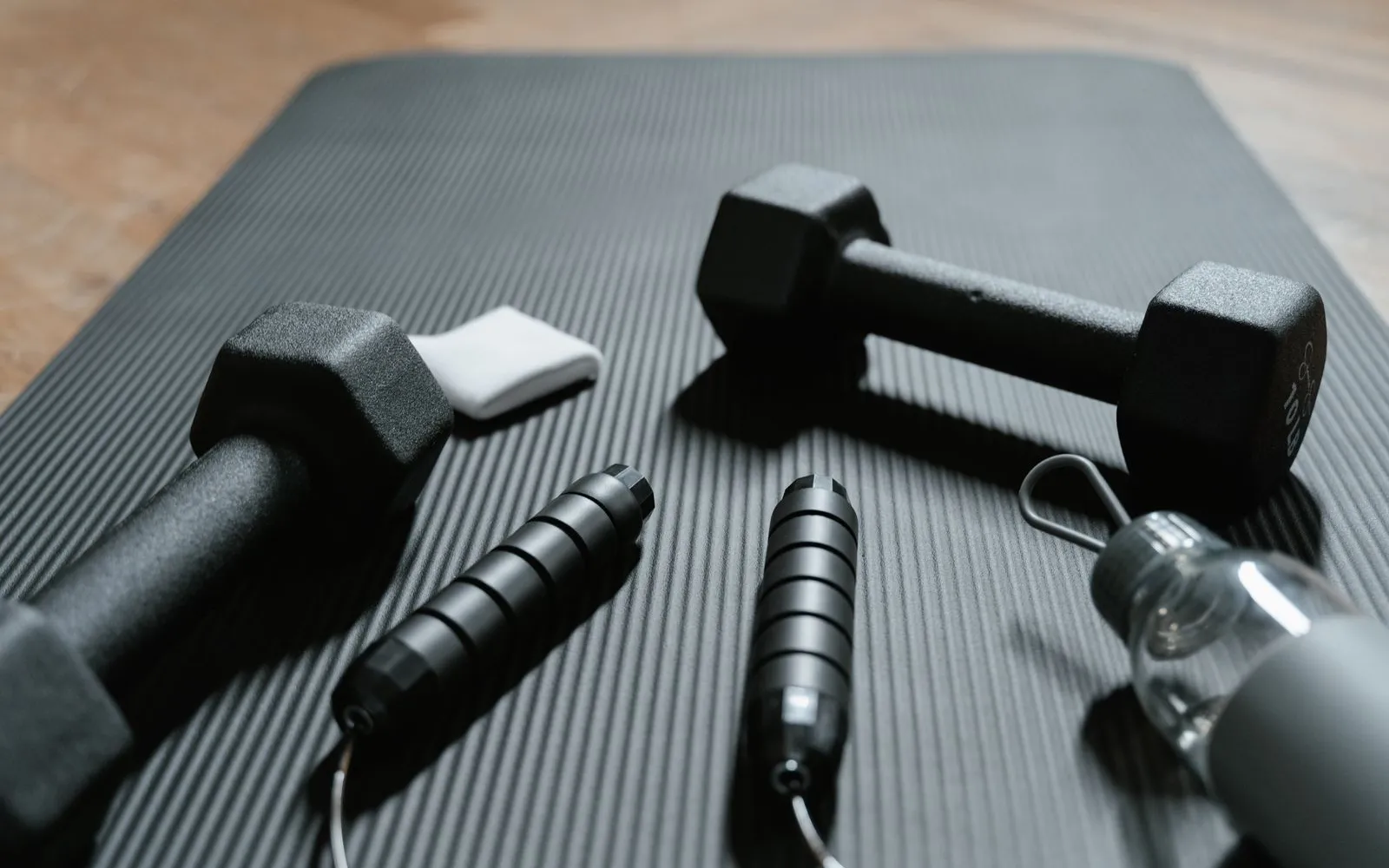
What do you need for a small home gym?
Three things: a sturdy chair, a resistance band and a pair of dumbbells. With those you can squat, push, pull and hinge (bend at the hips).
The Royal Osteoporosis Society (ROS) says one move from each of those four groups helps strengthen all your main muscles. That’s a whole workout.
| Move | Start with | Then try |
|---|---|---|
| Squat | Sit-to-stand from a chair | Squat holding one dumbbell at your chest |
| Push | Press-up against a wall | Press-up on the floor |
| Pull | Row with filled water bottles | Band row, or one-arm dumbbell row |
| Hinge | Bridge: lie on your back, lift your hips | Dumbbell Romanian deadlift (bend at the hips with a dumbbell in each hand, then stand up tall) |
Sources: Royal Osteoporosis Society; NHS
You don’t need it all on day one. The ROS says to start with your own body weight, then add bands and weights when you feel ready.
Pick your chair with care. The NHS says to use a solid, stable chair with no wheels and no arms, that will not slip. Find one today and try the first column.
How cheap can a home gym be?
It can cost nothing to start. The ROS suggests filled water bottles and tins of food as weights. The NHS uses water bottles for its biceps curls.
Build a cheap home gym in four stages
- 1
Free
A chair, the floor, filled bottles and tins.
- 2
Bands
For pulling moves, and to make others harder.
- 3
Dumbbells
Start with a weight you can lift easily.
- 4
Heavier
Go up when you can do 12 reps (repeats) and could keep going.
Sources: Royal Osteoporosis Society; NHS
Bands are a fair swap for weights while you build up. A review of eight studies found bands gave similar strength gains to weights and machines.
The authors rated those studies low quality, and they measured strength, not muscle size. So bands are a good start, not a proven match.
Train twice a week for a month with what you have. Then spend on the stage you’ve outgrown. See our resistance band workout for moves.
Do you need machines or heavy weights?
Not to start.
A review of 13 studies took in 1,016 adults aged 18 to 60, mostly men. It found no difference in strength or muscle between free weights and machines. The authors say the choice comes down to what you prefer.
Light weights can build muscle too. In 21 studies, light and heavy loads built similar muscle, but every set went on until the lifter couldn’t do another rep. Heavy loads built more strength for the heaviest weight you can lift once.
So a few dumbbells take you a long way. With light ones, keep each set going until you can’t do another rep. Start with our full body dumbbell workout or these free weight moves.
A home gym routine for beginners
Do the four moves from the first table in each session. The UK’s chief medical officers ask for strength work on at least 2 days a week, and say any is better than none.
| Question | The ROS plan |
|---|---|
| Reps | 8 to 12 in each set. |
| Sets | Build up to 3 sets (rounds) of each move. |
| Days | 2 to 3 a week, with at least a day’s rest in between. |
| Time | 20 to 30 minutes. |
| Too hard? | Can’t do 8 with good technique? Go lighter. |
| Too easy? | Can do 12 and could keep going? Go heavier. |
Source: Royal Osteoporosis Society
Each set should leave you needing a breather. The NHS says to work to the point where you need a short rest before you go again.
Strength work sits on top of at least 150 minutes of moderate activity, or 75 minutes of vigorous activity, a week. At home, the NHS counts walking up the stairs and skipping as vigorous. A skipping rope is cheap and small.
Put two days in your diary now. When the weights feel light, our guide to making it harder each week shows the next step.
How should you lay out a small home gym?
Plan for the dropped weight. In US emergency departments, the commonest cause of weight training injury was a weight dropping on the person. That was 65.5% of cases, and 90.4% involved free weights.
That study counts hospital visits, not risk per lifter. But it tells you where the danger sits: a weight falling on you.
Set up your space safely
- Keep weights on the floor or a low rack, not on a high shelf.
- Lift over a mat, with room to lie down and stretch your arms out.
- Use a solid chair with no wheels and no arms, that will not slip.
- Put the weights away after each session, so nobody trips on them.
- Tell young children the kit is not a toy, and store it out of their play space.
Sources: NHS; Kerr 2010; Nationwide Children’s
Children get hurt too. A US children’s hospital says over 12,000 children a year go to US emergency departments with home exercise equipment injuries. Children 4 and under are often hurt touching moving parts or falling onto kit.
No room for a corner gym? See our no-equipment home workout and strength training at home.
When to speak to a GP
Speak to a GP if:
- You haven’t exercised for some time, or you have medical conditions or concerns. The NHS says to speak to your GP first.
- You’ve had many broken bones or spinal fractures, or you’re recovering from a broken bone. The ROS says to talk to a doctor or physiotherapist first.
- A sprain or strain is getting worse, or not feeling better after treating it yourself. See a GP.
- You have chest pain that comes and goes, or goes away quickly but you’re still worried. See a GP.
Get help from NHS 111 after an injury if:
- It’s very painful, or the pain is getting worse.
- It’s very swollen or bruised, or getting more so.
- You cannot put weight on it or walk more than a few steps.
- It’s very stiff or hard to move.
- You also have a very high temperature, or feel hot, cold or shivery.
Call 999 if you have any of these. The NHS says you could be having a heart attack.
- Sudden chest pain or discomfort that does not go away. It can feel like squeezing, pressure, burning or indigestion.
- Pain that spreads to your arm, neck, jaw, stomach or back.
- Chest pain with sweating, feeling sick, light-headed or short of breath.
Call 999 or go to A&E after an injury if any of these happen. You may have broken a bone.
- You heard a crack.
- The body part has changed shape or points at an odd angle.
- It’s numb, tingling or has pins and needles.
- The skin around it is blue, grey or cold to touch.
Pregnant? The NHS lists strength training at a gym as an option if you do this already. In later pregnancy, avoid lying flat on your back for more than a few minutes, so swap the bridge.
Stop if you feel uncomfortable, too hot or unwell.